Family Office Philanthropy

Strategic Assessment of Philanthropy: Lessons for the Joyful Giver

All major faith traditions, ethical systems, and moral codes emphasize the importance of charitable giving. Saint Paul puts it succinctly: “He which soweth sparingly shall reap also sparingly; and he which soweth bountifully shall reap also bountifully.” The stoic philosopher and Roman statesman Seneca offers a complimentary view: “We should give as we would receive, cheerfully, quickly, and without hesitation; for there is no grace in a benefit that sticks to the fingers.”1

The highest goal then is to give cheerfully and without hesitation. However, the modern cynic, and probably you and I, for justifiably prudent reasons, would counter that one must also give responsibly. The joy of giving is easily crushed when donations produce little change or, worse, are wasted or stolen. By the same logic, increasing your philanthropic allocation will not proportionally increase your joy. Developing an informed approach is crucial.

Increasing Joy Without Decreasing Prudence

If giving should be joyful, then how can one increase joy without sacrificing the crucial role of diligence in order to make prudent and informed decisions? Looking through the lens of process can help diagnose and understand the overall ecosystem of a family office’s philanthropic work. A family office philanthropy team can enter the space with the best of intentions only to emerge jaded by bad faith actors and overly complicated structures. The result is that they become disenchanted with the potentially rejuvenating and rewarding work of giving, which then reverberates throughout the family office. In this scenario, rather than a source of joy, philanthropy becomes a burden, or just another way to build a tax efficient balance sheet. The fault doesn’t lie with any individual or organization, but rather emerges from a locus of forces and constraints that make it difficult to do philanthropy well.

The most fundamental force is simply the scale of the problem itself. An unintended consequence of being a global citizen is the inheritance and enormity of global problems. The scale of the problems are often so great that no individual or group of philanthropists alone can solve it. Against such large-scale problems, even large acts of giving appear like a drop in the bucket. But despite the enormity of the problems, and complexity of the system, one can still do philanthropy well. Doing so requires careful design and the ability to mediate a healthy cynicism with a sincere desire to improve the world in a meaningful way.

It’s for these reasons that family offices must proceed with the utmost care and caution — but proceed all the same. The rise of new qualitative metrics like Environmental, Social, and Governance (ESG) and the broader category of “Social Impact” evince the tidal shifts that are underway in public and private markets.2 The rise of impact investing is in part born out of the realization that the private sector has an immense influence over a host of non-financial outcomes.3

Despite these commercial trends, there will always be a need for philanthropic citizens; if for no other reason that not every worthy cause can (or should) be profitable. The division between philanthropy and ‘for-profit’ impact investment is complex and merits further analysis, but for our purposes it’s important to simply note that there are some endeavors that produce desirable social goods but will never themselves be profitable4.

Measuring Giving Practice

To help your assessment of your own family office’s approach to philanthropy, we offer four assessment ‘metrics’ for consideration. These metrics are qualitative in nature and are meant to inspire critical thinking and analysis. Alongside these metrics is a heuristic that offers one way to think about portfolio construction. The most important take away comes from the ancients themselves: giving should be joyful. If you are happy and content with your giving practices, then continue in your path as a joyful giver.

1. Fluidity

The concept of fluidity assesses the overall speed of your giving. How easy is it for you to give? How long does it take you to get comfortable with a new organization? The counterforce to fluidity is drag. These are not moral terms; speed is not a universal good and drag is not a universal bad. Philanthropy is much harder to analyze than investing because the return on philanthropic giving is social, not financial. The nation’s wealthiest individuals have voiced this sentiment. Elon Musk, on January 7, 2021, tweeted that finding impactful ways to donate money is “way harder than it seems.” While Musk is at the beginning of his philanthropic journey, the Bill and Melinda Gates Foundation has 1,600 employees and an endowed trust of $49.8 billion dollars. Even with a large staff and annual contributions from Warren Buffet, the foundation supported grantees with only $5.1 billion in 2019.5 Based on the Gates Foundation public disclosures, the organization could easily sustain an annual giving budget of about $7.5 billion and still remain within their stated goals and objectives. The need and the resources exist, but the processes and systems increase the drag and slow down the overall impact.

From a macro perspective, the problem of an illiquid philanthropic ecosystem is evinced through the capital held up in donor advised funds (DAF).6 In 2018 total contributions to DAFs grew by 20% to $37.12 billion. Total charitable assets in DAFs were $121.42 billion in 2018. Despite the increase in funds, the aggregate grant payout rate remains around 20%. While the DAF payout rate is higher than what private foundations are required to give, there is a tremendous amount of capital stuck in DAFs. Unlike an institution like a foundation, the purpose of a DAF is meant to streamline the giving process between making the gift and deploying the gift. Part of the disjointedness emerges because the benefit to giving to a DAF is secured once the gift is made, not when the gift is deployed. In other words, the incentives to make the gift are higher than the incentives to deploy the gift. If DAFs only deployed 20% of their assets in 2018, does that mean that there were only $24.28 billion dollars of worthy organizations? Given the scale of the national and global problems and the amount of human and ecological suffering, it would appear that the problem is not the lack of need, but rather the lack of fluidity.

Your success as a giver is secured through trust and knowledge, both of which require time and patience. As a general principle, the more you trust the individual or organization, and the more you know the details of their organization, as well as their mission, the more quickly and fluidly your giving will be. The conclusion of this paper outlines a few practical strategies that can help increase the overall fluidity of your philanthropic practices without losing the important and necessary work of diligence and building an informed understanding. As a family office philanthropist, reflecting on the fluidity of your own giving practices may help you discover new ways to optimize your overall practice.

2. Transparency

There are two lenses through which one can analyze transparency: authenticity and integrity. Authenticity captures the extent to which claims line up with actions and intentions. Integrity speaks to how the practices of the organization fit within a larger social and economic milieu.

Authenticity is the surest way to establish trust in an organization. Do they do what they say and are their operations open for careful diligence? In extreme cases, inauthentic organizations may be acting fraudulently, however a more common occurrence is simply the marketing claims of the organization not living up to the experience and practices on the ground. Because there is such a strong connection between the story of an organization and their ability to attract donors, sometimes the claims of the organization outgrow the operations. Stakeholder analysis as well as program and financial analysis and track record are critical factors for any analyst here.

The concept of integrity, in this instance, refers to the human, social, and economic stability of the mission of the organization. A clear example of an unstainable practice is found in the practice of donating basic supplies – like clothes – to poor nations. In the case of Haiti, donated T-shirts end up being sold for pennies on public markets. The result disrupts the local economy, puts skilled craftsman like tailors out of work, erodes community-based knowledge, and creates a dependency between the developed and undeveloped world that cannot be easily undone.7

There’s no easy way to analyze the sustainability of an organization but empowering your team to investigate the secondary and tertiary consequences of an organization, with the same level of rigor that they bring to private investment opportunities, and working with experts in the space will help build a more sound and thoughtful overall strategy and mission to your philanthropic activity. Becoming a subject-matter expert in a specific region or theme allows you and your team to build a specific knowledge base in order to understand the major players and the best and most effective strategies.

3. Efficiency and Effectiveness

While the concept of fluidity and drag represent one way to understand efficiency, the concept broadly speaks to all the forces that either impede the flow of capital or dilute the use of capital. Drag is both quantitative and qualitative. There are ways to measure the efficiency of the gift, but one must also reflect on the other forces that are causing one to “drag their feet.” Is the gift outside of your comfort zone, do you have reservations about the organization, do you question the larger impact and purpose of the gift, are there competing interests that make an equally strong case for another kind of organization?

As was the case with DAFs, analyzing the relationship between the dollars committed vs the dollars deployed is one way to measure overall portfolio efficiency. Another equally important metric is the measurement of operational overhead vs deployed capital. It’s not always the case that low overhead costs mean well managed money. More important is the organizations justification and analysis of their own overhead costs and how those line up with your own ideas. Robust organizations that are looking to build a charitable legacy need to create worthy incentive structures in order to attract and retain top talent. Similar to building a family office team, finding the perfect balance between operational efficiency and rewarding incentives is an ever-evolving dynamic. When it comes to philanthropic activity, the best place to begin is simply with validating the claims of the organization itself. For example, “Food for the Poor”, got into trouble because its marketing claims used cash and noncash donations to appear much more efficient than it actually was. Eventually the state of California issued a cease-and-desist order to “Food for the Poor” and this is a cautionary tale in the importance of careful diligence8. Although your gifts will not be measured through an ROI, it is vital to work with experienced professionals that can help identify robust, authentic, and well-designed organizations that will help you achieve the social objectives of your philanthropic gifts. Those that you empower to help steward your capital toward these ends must be as diligent and rigorous as the investment team that structures and negotiates private investment or public securities.

4. Joy

It’s difficult to write about joy in a rigorous way, but it may be the most foundational and important ‘metric’ on this list. Giving should be joyful. When organizations you’ve given to in the past call you, or your philanthropy team reaches out to have a meeting, do you feel joy or dread or nothing at all? If the feelings are negative, then it may be time to undergo a deeper review of your overall strategy and goals. If you already experience joy, then how can you continue to foster and grow that experience for yourself, your team, and your peers? One important relationship is the connection between joy and knowledge. By joy, we’re not referring to the superficial rush one experiences when one makes a large gift. The kind of joy outlined by St Paul and Seneca is sustainable and grounded in knowledge. Making informed choices and knowing that your actions are making a real and significant impact in the world create a foundation for becoming a joyful giver.

Putting These Metrics into Practice

Hopefully these four metrics help put your own giving practices into perspective. If that’s the case, then there are some easy-to-implement strategies to improve your giving practice. First: Curate your portfolio. Pick a few organizations to get seriously involved with. Organizing around a specific theme is a great place to start. Second: Become a subject matter expert. Build a knowledge base around the theme, expert writers and thinkers, and major organizations and efforts. Third: Identify opportunities for outsized impact. Large gifts can seem small when given to massive foundations; alternatively, local organizations or more niche strategies may allow you to make a massive difference within a particular area. Extra diligence is required when working with newer organizations, but the opportunity to grow alongside an organization while it builds out its capabilities Finally: Become engaged with the community. Get to know the groups that you’re most active with and look for opportunities to become a board member or advisor.

While these strategies offer a framework for deploying enlightened capital, you can supplement this strategy with a separate pool of funds for more spontaneous gifts, akin to a pipeline for future opportunities and research. From a risk management perspective, 80% of your allocation may be dedicate to your core area, while 20% you keep on reserve for new opportunities.

We hope by putting the above strategies in place it will help you to add more joy to your giving!

Notes

  1. For more of Seneca’s writings on charity, see On Benefits, perhaps the first extended work on the nature, purpose, and value of charity.
  2. For our thoughts on ESG and Impact Investing, see our earlier publication “Impact Investing: What Family Offices Must Consider.” https://tfoa.info/wp-content/uploads/2021/01/Whitepaper-2.0-Impact-Investing.pdf
  3. According to Charity Navigator, philanthropic dollars represent only 2% of GDP. While that 2% can make a tremendous impact, they must be managed and deployed with utmost care. https://www.charitynavigator.org/index.cfm?bay=content.view&cpid=42
  4. Education is one example: the value of an education is unmistakable, but the gains themselves may not be realized for years or for generations. Hospitals and healthcare are also excellent examples. Hospitals in the 19 th century were largely funded through religious organizations and churches. Their existence was wholly dependent on philanthropic commitments. Today we view hospitals and healthcare as an essential part of our society, not merely as an act of charity.
  5. Gates Foundation Fact Sheet.
  6. See Mark Schoeff Jr. “A Better Way of Giving,” Investment News , 22 March 2020. and the National Philanthropic Trust’s 2018 DAF Report:
  7. Patrick Moynihan has written about this exact phenomenon, which he witnessed first-hand during his time with The Haitian Project.
  8. Martin Levine, NPQ: Nonprofit Quarterly , “Food for the Poor: Questionable Tactics Threaten its Credibility and Reputation. 6 June 2018

About the Authors

Marc J. Sharpe is the founder and Chairman of TFOA, an organization formed in 2007 to provide a forum for education and networking and to serve as a resource for single family office principals and professionals to share ideas and best practices, pool buying power, leverage talent and conduct due diligence. Mr. Sharpe also teaches an MBA class on “The Entrepreneurial Family Office” as an Adjunct Professor at Rice University and SMU Cox School of Business. Contact: marc@tfoa.me

Patrick Moynihan is a leader in the nonprofit space with experience as an educator, a community builder, who spent the past 25 years successfully reviving and then expanding an educational institution, in Haiti, one of the Western Hemisphere’s poorest nations. Patrick has seen the best and the worst in the global philanthropy and he launched Moynihan Philanthropic Advisors (MPA) in 2020 to share his knowledge and help funders gain the confidence to invest their philanthropic dollars more quickly and accurately, increasing its impact. Patrick graduated magna cum laude from Brown University and earned a Master of Arts Degree with distinction in Religious Studies from Providence College. Ordained a permanent deacon for the Roman Catholic Diocese of Rockford (IL) in 2001, he is currently assigned to St. Sebastian, Sebastian, FL and lives with his wife, Christina, in Vero Beach, FL.

Seth Morton, Ph.D. has served family offices in areas of investment diligence, execution, and management; governance; research; communications; and multi-generational, sustainable legacy planning. He seeks to improve team performance by cultivating learning-focused and communications-driven processes that deliver exceptional results. He and his family are currently based in Texas.

About TFOA

The Family Office Association (“TFOA”) is a global peer network that serves as the world’s leading single family office community. Our group is for education, networking, selective co-investment, and a resource for single family offices to share ideas, deal flow and best practices. Members are not actively marketing products or services to other members and no contact information or email lists will ever be shared. Since our founding in 2007, TFOA has led the global single family office community by delivering world-class educational content, unique networking opportunities, and exceptional thought leadership to our highly curated network of the world’s largest and wealthiest families: www.tfoa.info

Disclosures

The Family Office Association (“TFOA”) is a peer network of single family offices. Our community is intended to provide members with educational information and a forum in which to exchange information of mutual interest. TFOA does not participate in the offer, sale or distribution of any securities nor does it provide investment advice. Further, TFOA does not provide tax, legal or financial advice. Materials distributed by TFOA are provided for informational purposes only and shall not be construed to be a recommendation to buy or sell securities or a recommendation to retain the services of any investment adviser or other professional adviser. The identification or listing of products, services, links, or other information does not constitute or imply any warranty, endorsement, guaranty, sponsorship, affiliation, or recommendation by TFOA. Any investment decisions you may make based on any information provided by TFOA is your sole responsibility. The TFOA logo and all related product and service names, designs, and slogans are the trademarks or service marks of The Family Office Association. All other product and service marks on materials provided by TFOA are the trademarks of their respective owners. All of the intellectual property rights of TFOA or its contributors remain the property of TFOA or such contributor, as the case may be, such rights may be protected by United States and international laws and none of such rights are transferred to you as a result of such material appearing on the TFOA web site. The information presented by TFOA has been obtained by TFOA from sources it believes are reliable. However, TFOA does not guarantee the accuracy or completeness of any such information. All such information has been prepared and provided solely for general informational purposes and is not intended as user specific advice.

Frequently Asked Questions

How do family offices approach philanthropy?

Family offices approach philanthropy through a range of vehicles including private foundations, donor-advised funds (DAFs), charitable remainder trusts, and direct grants. The choice depends on the family's desire for control and anonymity, the scale of giving, and whether they want the philanthropic entity to be a lasting institution or a flexible tool.

What is the difference between a private foundation and a donor-advised fund for family philanthropy?

A private foundation is an independent legal entity controlled entirely by the family, with the ability to make grants, hire staff, and shape its own programs — but subject to 5% annual distribution requirements, excise taxes, and extensive reporting. A donor-advised fund offers simplicity and anonymity: the family contributes assets, takes an immediate tax deduction, and recommends grants over time without the administrative burden of a foundation.

How do family offices integrate philanthropy with investment strategy?

The most sophisticated integration is through mission-related investing (MRI) and program-related investing (PRI), where the family's investment portfolio is aligned with its philanthropic goals. A family focused on climate, for example, might screen out fossil fuel companies from its investment portfolio, invest in climate technology, and direct philanthropic capital to policy and advocacy organizations.

What role does next-generation engagement play in family philanthropy?

Philanthropy is one of the most effective tools for engaging the next generation in the family office's mission. Giving younger family members meaningful roles in grant-making decisions — including their own grant budgets — teaches financial decision-making, builds values alignment, and creates shared purpose across generations.

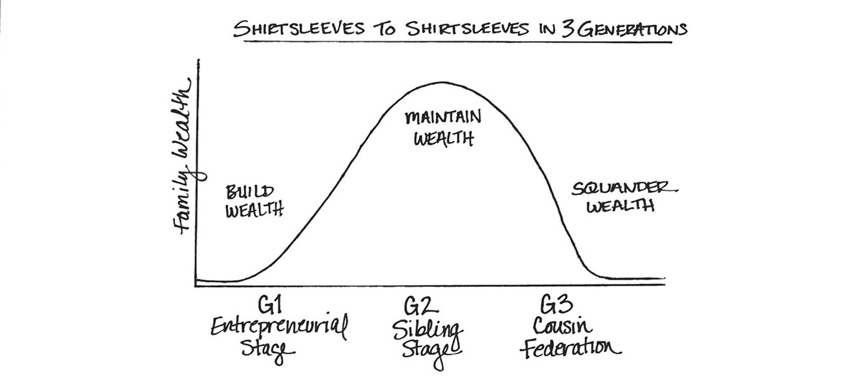
Family Wealth in Three Generations

Fact or Fear-Based Marketing?

First generation families who are in the process of building a family office often receive the same piece of conventional wisdom: that family wealth passes from “shirtsleeves to shirtsleeves in three generations.” A punchier version is also frequently quoted : “Generation one makes it, Generation two spends it, Generation three blows it.” But where does this ‘universally accepted’ conventional wisdom come from? And why is it so ubiquitous among family office service providers and wealth advisors in the marketplace?

Shirtsleeves to shirtsleeves in three generations

In 2021, Josh Baron and Rob Lachenauer wrote an article in the family business section of the Harvard Business Review that calls into question the validity of this oft quoted phrase.1 They go on to question the very foundation upon which so much advice has been rendered to wealthy families looking to build their legacy. For Baron and Lachenauer, the expression traces back to a decades old study of manufacturing companies in Illinois. They also cite other studies regarding the dynamics of multi-generational wealth that suggest wealthy families tend to stay wealthy. Given Baron and Lachenauer’s research, it’s worth reexamining the phrase, both for its value and for the ways it may unfairly or inaccurately portray the dynamics of family wealth. And, of course, we shouldn’t forget how the Estate Planning and Private Wealth ‘industrial complex’ uses this broadly accepted concept to help their clients (and make more money).

While Baron and Lachenauer cite a 1980s study as their starting point for this concept as it relates to family offices, James E. Hughes used this phrase in the beginning of his landmark text Family Wealth, first published in 1997.2 Hughes used this phrase to not only shape the purpose of his book, but also his entire career. He found both the international character and the utilization of intergenerational dynamics uniquely compelling and appropriate for his work. Hughes, and others after him, observed that many cultures have some version of this expression. Indeed, its international ubiquity is quite remarkable. Germanic, Romantic, Slavic, and Asian cultures all seem to possess some version of this expression.

  • In China: “From peasant shoes to peasant shoes in three generations.”
  • In Mexico: “Father-merchant, son-gentleman, grandson-beggar.
  • In Brazil: “Rich father, noble son, poor grandson.”
  • In Italy: “From the stables to the stars and back to the stables in three generations.”

For Hughes, this expression speaks to a universal dynamic that informs family wealth. He himself was quite explicit in his writing that the purpose of his life, working with families and family offices, was dedicated to discovering the traits successful families use to break this cycle and to help other families implement best practices so that they might avoid this fate. Anecdotally, he observes a number of families that were unable to overcome this dynamic. Those families splintered and the wealth became fractured and lost. There are innumerable examples of this in the literature. For instance, in 2017 Frances Stroh wrote a heartfelt and personal memoir called Beer Money: A Memoir of Privilege and Loss, which detailed her family’s rise and precipitous fall. Stroh was the heiress to what was at the time the largest private beer company in the United States. Her book details the myriad forces that dismantled her family’s fortune. Some of these were macroeconomic conditions, but many had to do with tensions, disagreements, and losses within the family across multiple generations. Happily, Stroh was able to rebuild a small portion of her family’s wealth and turned it toward reinvestment in Detroit, as well as engagement with non-profits operating in the Detroit area. While Stroh has shared her family story with the public, anyone with experience in the family office world is familiar with stories like hers. Stroh herself said that after publishing the book many people reached out to her to tell their own story of lost family fortunes.3

Examples like the Stroh family suggest there is some wisdom within the shirt-sleeves expression. Many of the best practices in family office design are built with an eye toward preparing the next generation of family leadership and helping to enshrine the values of one generation for future generations. This work helps make family offices resilient and dynamic organizations that can evolve and grow over time. However, Baron and Lachenauer are correct to call into question the assumptions that are embedded with this blanket statement. Despite the accepted wisdom the phrase captures, it is often used in a fatalistic fashion, as a scare tactic for any family thinking about creating a family office: “if you don’t listen to our advice, you grandchildren may have nothing”. Sadly, the fatalism of this expression is frequently used as a marketing technique by estate planners and wealth advisors, and as a scare tactic, meant to elicit a fear-based reaction.

The reality is, of course, more complex. According to Gregory Clark, an economist at UC Davis who studies social mobility, when it comes to elite families, the regression to the mean occurs over centuries, not generations. Clark’s study focuses on elite English surnames from the 12th century to the 19th century. He found a remarkably consistent retention of elite status across that 700 year period4. Similarly, many of today’s wealthiest families in Italy trace their lineage to the Renaissance5. Clearly the picture of dynastic family wealth is more complex than an aphorism about poor tailoring. So, what does this all mean for you and your family office?

First, if someone is using this expression with you, be sure to carefully consider the context and purpose of its use. One should always be wary of those using scare tactics to garner attention and obfuscate rational decision making. Hughes offers the best example of how to use this expression well. For him the expression was just the beginning. The value that he brought to countless families was through the very real and tangible processes and systems he designed to help families govern themselves more effectively. Hughes’ work is not cold and impersonal. As an attorney he understood the formal legal structures that underpin a family office, but he also understood that the legitimacy and efficacy of these structures was more a function of culture and relationships. His work brings to light a humanistic character to family office governance. The ultimate truth that he drew from the “shirtsleeves” expression is that institutional family wealth is made up of individual participants and those individuals have their own ideas, both rational and irrational, that shape how that wealth is managed. Given this understanding, Hughes turned his focus to understanding behavior, looking for models to help each individual achieve their very best.

Second, consider the source. One of the most valuable assets that a new family office can utilize is a trusted peer network of similar families that have managed their generational transition well.6 In lieu of those networks, finding individuals who have delivered real results in this area is worth much more than an oft cited platitude about multi-generational family wealth transfer.

Finally, while economic data show that family wealth is more resilient than sometimes appears, this doesn’t mean that foundational practices like governance and legacy planning are futile exercises. Devising a plan and creating a culture for rising generations to grow and develop their own form of leadership are essential practices for any family office seeking a multi-generational enterprise. As Hughes’ work shows us, these efforts are more than complex legal structures. They must also put the family and their vison, hopes, and objectives at the center. This shouldn’t be a fear-based process, but rather a deliberate and thoughtful process to enable the very best personal and professional outcomes for your family, business, and family office.

Notes

  1. Josh Baron and Rob Lachenauer, “Do Most Family Businesses Really Fail by the Third Generation?” Harvard Business Review Blog, 19 July 2021. https://hbr.org/2021/07/do-most-family-businesses-really-fail-by-the-third-generation
  2. James E Hughes, Family Wealth: Keeping it in the Family . Bloomberg Press, 1997.
  3. https://www.nytimes.com/2017/02/19/your-money/losing-a-fortune-often-comes-down-to-one-thing-family.html
  4. https://www.livescience.com/48951-surnames-social-mobility.html
  5. https://www.vox.com/2016/5/18/11691818/barone-mocetti-florence
  6. In an earlier whitepaper, “Family Office Networks, Clubs, and Associations: What Would Groucho Marx Do?” we provide an analysis of the most common business models for family office networks as well as helpful considerations for each type.

About the Authors

Marc J. Sharpe is the founder and Chairman of TFOA, an organization formed in 2007 to provide a forum for education and networking and to serve as a resource for single family office principals and professionals to share ideas and best practices, pool buying power, leverage talent and conduct due diligence. Mr. Sharpe also teaches an MBA class on “The Entrepreneurial Family Office” as an Adjunct Professor at Rice University and SMU Cox School of Business. Contact: marc@tfoa.me

Seth Morton, Ph.D. has served family offices in areas of investment diligence, execution, and management; governance; research; communications; and multi-generational, sustainable legacy planning. He seeks to improve team performance by cultivating learning-focused and communications-driven processes that deliver exceptional results. He and his family are currently based in Texas.

About TFOA

The Family Office Association (“TFOA”) is a global peer network that serves as the world’s leading single family office community. Our group is for education, networking, selective co-investment, and a resource for single family offices to share ideas, deal flow and best practices. Members are not actively marketing products or services to other members and no contact information or email lists will ever be shared. Since our founding in 2007, TFOA has led the global single family office community by delivering world-class educational content, unique networking opportunities, and exceptional thought leadership to our highly curated network of the world’s largest and wealthiest families: www.tfoa.info

Disclosures

The Family Office Association (“TFOA”) is a peer network of single family offices. Our community is intended to provide members with educational information and a forum in which to exchange information of mutual interest. TFOA does not participate in the offer, sale or distribution of any securities nor does it provide investment advice. Further, TFOA does not provide tax, legal or financial advice. Materials distributed by TFOA are provided for informational purposes only and shall not be construed to be a recommendation to buy or sell securities or a recommendation to retain the services of any investment adviser or other professional adviser. The identification or listing of products, services, links, or other information does not constitute or imply any warranty, endorsement, guaranty, sponsorship, affiliation, or recommendation by TFOA. Any investment decisions you may make based on any information provided by TFOA is your sole responsibility. The TFOA logo and all related product and service names, designs, and slogans are the trademarks or service marks of The Family Office Association. All other product and service marks on materials provided by TFOA are the trademarks of their respective owners. All of the intellectual property rights of TFOA or its contributors remain the property of TFOA or such contributor, as the case may be, such rights may be protected by United States and international laws and none of such rights are transferred to you as a result of such material appearing on the TFOA web site. The information presented by TFOA has been obtained by TFOA from sources it believes are reliable. However, TFOA does not guarantee the accuracy or completeness of any such information. All such information has been prepared and provided solely for general informational purposes and is not intended as user specific advice.

Frequently Asked Questions

What does 'shirtsleeves to shirtsleeves in three generations' mean?

This proverb — found in cultures around the world — describes the common pattern of wealth being created in the first generation, enjoyed and somewhat dissipated in the second, and largely gone by the third. Research suggests this pattern is more the norm than the exception, driven by inadequate preparation of heirs, family conflict, and poor governance.

How do families successfully transfer wealth across generations?

Successful multi-generational wealth transfer combines financial planning (estate structures, trusts, gifting strategies) with family capital development — educating the next generation about money, investing, and responsibility, establishing shared family values and governance, and gradually transitioning decision-making authority as younger members demonstrate capability.

What is the role of the family office in next-generation education?

The family office often serves as the primary vehicle for next-generation financial education — through structured programs, shadowing of investment professionals, participation in family governance meetings, and gradually increasing involvement in investment decisions. Some family offices fund formal education programs or engage outside advisors specializing in family wealth education.

What is a family governance framework for wealth continuity?

A family governance framework is the set of structures and processes that guide collective decision-making — including a family council, investment committee, family constitution, regular family meetings, and defined rules for family participation in the family office. Strong governance is the most reliable predictor of long-term wealth continuity.

Family Offices and Digital Assets

How Should Family Offices Approach Digital Assets?

Introduction

“Fear of Missing Out” (aka FOMO) is that anxious feeling of not being included in something with others, such as an interesting or enjoyable activity. The concept was originally used to describe social behavior, a form of self-inflicted peer pressure to participate in social activities. More recently the term has been taken up by the behavioral finance community to describe how investors follow the trades of others in order to “not miss out” on the next big thing. FOMO is a common experience, but in the world of investing it is usually associated with poor decision-making. After all fear rarely provides a solid basis for clear, rational decision making.

The massive breakouts in Bitcoin and other digital assets in the past few years have created many FOMO inducing moments. At The Family Office Association (“TFOA”) members experienced such a moment in late 2017. TFOA often hosts dinners for our family office members to meet with industry experts and learn from leading practitioners about a variety of topics. Over the years we have found that one of the best ways to diligence a manager is during a private dinner where questions and ideas can be openly asked and answered. Our dinner conversations tend to be both candid and fun; and our diverse membership of experienced family office CIOs, CEO’s, Principals and Presidents provide unique and different perspectives.

For this particular dinner we invited the head of a relatively new crypto fund to host a dinner for members in the private room of Pappas Bros. Steak House in Houston, TX. An impressive oak paneled room with wine racks from floor to ceiling offered members the intimacy of a closed door private meeting and the perfect setting for friends and colleagues to visit. The theme of the dinner was “The Facts, not Hype, of Crypto and Blockchain.” At the time the fund’s assets under management were small, around $40M, but the founder was exceptionally knowledgeable about the space and members were keen to learn more about what was really going on and how they should best position themselves. The conversation was fascinating. Many questions were asked, steak eaten, and wine drunk. However, it was perhaps a little early in the evolution of crypto for some of the more skeptical participants to see how this interesting new technology might translate into a viable asset class. Other members saw the potential for asymmetric upside and followed up with the manager after dinner to learn more. The skepticism of those members who chose not to invest wasn’t entirely misplaced as, five years later, digital assets are still perceived by many to be pure risk capital. After all, not many assets maintain a valuation range from zero to infinity, which is what digital assets currently appear to offer. For those that didn’t choose to invest, it is understandable that at that time the opportunity appeared too aspirational and too technical. Five years ago, there was still much to understand about this new asset class. Today, the fund manager who hosted that dinner now overseas an investment business with more than $6.5 billion in assets under management (with much of that growth from investment performance). Like we said, the experience created a FOMO inducing moment!

In hindsight it was an obvious bet, but the fact of the matter is that in 2017 the most common question surrounding crypto was simply “what is crypto?” Today the question is more along the lines of “what is your crypto strategy?” The conversation has moved considerably in five years. Having said that, and despite how much more knowledgeable we all are today, many family offices are still in the process of developing their own approach to digital assets.

According to UBS’ 2021 Global Family Office Report, 13% of family office respondents have already invested in cryptocurrencies, and an additional 15% have it under consideration.1 Family offices are ahead of institutional investors, who are just now beginning to dip their toes into the space, but the asset class still remains outside a traditional asset allocation. As family offices continue to develop their post covid allocation strategies in parallel with the increasing awareness and adoption of digital assets from a broad spectrum of investors (from retail to institutional), it is more important than ever for families to consider how digital assets may or may not fit into their allocation strategies. To that end we would like to offer some perspectives to help frame how family offices might approach the topic.

1. Risk Capital

First and foremost, digital assets should be considered pure risk capital. And from a family office perspective, it makes sense to frame a crypto strategy within the overall risk capital budget. Digital assets are new, largely unregulated, and based on technology that is quickly evolving. The lack of regulation has made it exceedingly difficult to invest with conviction for any professional investor or those with a fiduciary responsibility to others. This framework is changing, and institutional investors are beginning to allocate a portion of their risk budget toward digital assets. The continued development of institutional fund strategies is accelerating that process. From a risk calculation perspective, a relatively small allocation can yield tremendous upside.

New coins and tokens can be quickly developed with open source coding, but the resilience of these new coins is largely based on how many people invest, adopt, and remain committed to a particular coin. This means that many emergent coins are very much tied to the success of their marketing campaigns. Therefore, picking coins carries the same kinds of risks as betting on horses at the racetrack – while they look promising, with great form, there’s no guarantee they won’t fall at the first furlong – so finding experts in the space and investing in the underlying technology seems more prudent than simply following Reddit discussion boards or other online communities.

Crypto bears have pointed to China’s recent regulations and the banning of miners while bulls point to El Salvador’s President Bukele who named Bitcoin legal tender for the country in 2021. The more established crypto currencies, like Bitcoin and Ethereum, have established a much larger and stickier share of the market. In the case of Bitcoin, the algorithm is designed to produce a fixed number of total coins, which will be completely mined by around 2140. Although the technology is new, the concept of limited supply serving as a store of value is not. However, if your primary motivation toward Bitcoin is as a store of value, then you must be mindful of how you plan to access that store of value. This is as much a question of privacy and security logistics as it is technology. Physical wallets allow you hold your coins but add an additional layer of risk. If the drive is lost or destroyed, your coins are gone as well. On the other hand, in a situation where you need access to your coins quickly, nothing can beat the speed and efficiency of a digital wallet that you fully control.

2. Patient Capital

Family offices are uniquely positioned to take advantage of investments over a long time frame. Many have the luxury of being able to deploy capital over generations. While Bitcoin prices may swing wildly on any given day, if your conviction about Bitcoin is based on a belief that it is Gold 2.0 and a better store of value, it’s not unreasonable to conclude that given the limited supply and algorithmic nature of the blockchain, the ultimate value of Bitcoin move higher over the long term.

Currently the IRS treats virtual currencies as property, and they are taxed in accordance with capital gains. However, other government agencies are arguing for different classifications. Not surprisingly, the SEC sees digital assets as securities while the CFTC believes they are commodities. While it is reasonable to assume a “J-Curve” pattern with the asset class in relation to future regulation – the assumption being that regulation will eventually drive down valuations as some investors don’t agree with the regulatory framework, but that over time regulation will make it easier for institutional investors to move in with greater force, thus raising long term valuations far above the initial dip – nobody knows exactly what the time frame for such a development might be. In the meantime, digital assets remain risky by nature but over the long term winners will emerge and there can be no denying that blockchain technologies offer a tantalizing prospect for decentralized finance and smart contracts.

3. Flexible Capital

In addition to patient capital, families also have access to flexible capital, namely, they can deploy capital with a flexible mandate that does not only require profit maximization, but also take into consideration legacy and impact. From this perspective, an allocation to digital assets must fit within an impact investing or ESG framework. An investment in digital assets should be flexible in the sense that it may generate positive or negative social or environmental returns, but it should also be tactically flexible given the rapidity of development within the space. Today, each Bitcoin requires energy consumption totaling 1173 kWh/ per transaction, which in U.S. energy terms would equal about six weeks’ worth of average household electricity.2 Other coins and new technologies are significantly driving down the energy load for transactions. Questions around energy usage will continue to be a feature in the discussion around digital assets. It is a complex topic. While digital assets appear to use more energy than other forms of currency, is anyone tracking how much energy is expended to mine for gold or run a global fiat banking system? The relative impact of digital asset energy usage needs to be weighed against the environmental costs of producing other stores of value, like gold mining, which rely on heavy machinery and industry. And digital assets have the ability to utilize forms of energy and electricity that would otherwise be wasted or are currently underutilized. Of course, heavy industry also benefits the economy by creating jobs. Given the complexity of the subject, the many competing narratives probably tell you more about personal biases towards crypto currencies than anything else.

For family offices, what is most important is understanding what the question of digital energy means for you, and this question highlights the importance of flexible capital. If a family office can’t reconcile the energy requirements of certain digital assets against their ESG mandate, there may be other strategies that better align with their goals. For example, Bitcoin mining operations that seek to stabilize and more efficiently utilize the electricity grid may be one such example. Indeed, the speed at which new technologies are coming online to solve these issues is startling, even within the context of a disruptive sector. On the other hand, placing too much faith in technology to solve problems is a common fallacy, so it is prudent to approach new solutions with a certain amount of skepticism3.

Beyond FOMO

Trains or tulips? As we think about digital assets in the context of the long history of capitalism, examples of transformative industries like the railway industry come to mind; followed quickly by the famous Dutch tulip craze with its ultimate and inevitable flop. Will digital assets prove to be more like the former or the latter?

Perhaps it’s still too early to say, but even if one’s convictions are on side of trains rather than tulips, it’s important to remember the rail industry took many years and saw many failures before stabilizing into a successful system of logistics and travel. History teaches us that family office allocators can’t afford to make decisions based on hype or excitement. Fortunately, in addition to all the FOMO around this asset class, there is also a growing body of knowledge and resources to help develop strategies for prudently allocating to digital assets.

Since the Great Recession, the market size of crypto currencies has swelled from zero to trillions of dollars. That’s a lot considering only a few years ago Bitcoin investors were perceived as fringe actors in a speculative technology with mysterious origins and a uniquely libertarian philosophy. Many of these pioneers are now immensely rich and the future for crypto, decentralized finance, blockchain, and the metaverse, seems boundless and unlimited. While family offices should proceed with caution, today there is no excuse for not ‘going down the rabbit hole’ to better understand digital assets and develop an approach that fits their strategic asset allocation goals and objectives.

About the Authors

Marc J. Sharpe is the founder and Chairman of TFOA, an organization formed in 2007 to provide a forum for education and networking and to serve as a resource for single family office principals and professionals to share ideas and best practices, pool buying power, leverage talent and conduct due diligence. Mr. Sharpe also teaches an MBA class on “The Entrepreneurial Family Office” as an Adjunct Professor at Rice University and SMU Cox School of Business. Contact: marc@tfoa.me

Seth Morton, Ph.D. has served family offices in areas of investment diligence, execution, and management; governance; research; communications; and multi-generational, sustainable legacy planning. He seeks to improve team performance by cultivating learning-focused and communications-driven processes that deliver exceptional results. He and his family are currently based in Texas.

About TFOA

The Family Office Association (“TFOA”) is a global peer network that serves as the world’s leading single family office community. Our group is for education, networking, selective co-investment, and a resource for single family offices to share ideas, deal flow and best practices. Members are not actively marketing products or services to other members and no contact information or email lists will ever be shared. Since our founding in 2007, TFOA has led the global single family office community by delivering world-class educational content, unique networking opportunities, and exceptional thought leadership to our highly curated network of the world’s largest and wealthiest families: www.tfoa.info

Disclosures

The Family Office Association (“TFOA”) is a peer network of single family offices. Our community is intended to provide members with educational information and a forum in which to exchange information of mutual interest. TFOA does not participate in the offer, sale or distribution of any securities nor does it provide investment advice. Further, TFOA does not provide tax, legal or financial advice. Materials distributed by TFOA are provided for informational purposes only and shall not be construed to be a recommendation to buy or sell securities or a recommendation to retain the services of any investment adviser or other professional adviser. The identification or listing of products, services, links, or other information does not constitute or imply any warranty, endorsement, guaranty, sponsorship, affiliation, or recommendation by TFOA. Any investment decisions you may make based on any information provided by TFOA is your sole responsibility. The TFOA logo and all related product and service names, designs, and slogans are the trademarks or service marks of The Family Office Association. All other product and service marks on materials provided by TFOA are the trademarks of their respective owners. All of the intellectual property rights of TFOA or its contributors remain the property of TFOA or such contributor, as the case may be, such rights may be protected by United States and international laws and none of such rights are transferred to you as a result of such material appearing on the TFOA web site. The information presented by TFOA has been obtained by TFOA from sources it believes are reliable. However, TFOA does not guarantee the accuracy or completeness of any such information. All such information has been prepared and provided solely for general informational purposes and is not intended as user specific advice.

Frequently Asked Questions

How are family offices approaching digital asset investing?

Family offices are approaching digital assets through a range of strategies: direct holdings of major cryptocurrencies (primarily Bitcoin and Ethereum), investments in blockchain-focused venture funds, participation in tokenized real-world asset platforms, and exposure to digital asset infrastructure such as mining and custody operations.

What percentage of family office portfolios is allocated to digital assets?

Survey data suggests that approximately 25% to 35% of family offices have some exposure to digital assets, with typical allocations of 1% to 5% of total portfolio for those with established positions. A smaller number of more conviction-oriented offices have allocations of 10% or more.

What are the custody risks for family offices holding digital assets?

Custody is the primary operational risk in digital asset investing. Family offices must choose between self-custody (controlling private keys directly, with high security burden), institutional custody (using regulated custodians such as Coinbase Custody or Fidelity Digital Assets), or a hybrid approach. Regulatory-compliant institutional custody is the standard for most SFOs.

How do family offices conduct due diligence on digital asset investments?

Due diligence for digital asset investments requires evaluating the underlying protocol or technology, team credentials and track record, tokenomics and incentive structures, regulatory status and legal risk, liquidity profile, and custody and security arrangements. Many family offices engage specialized digital asset advisory firms to supplement internal capabilities.

Multi Family Offices

Theory vs. Practice

What is a Multi Family Office?

The concept of the Multi Family Office (“MFO”) appears to offer the best of all possible worlds for a wealthy family who isn’t ready (or perhaps large enough) to start a Single Family Office (“SFO”) of their own. Under one roof it promises a convenient repository for all documentation, reduced overhead, consolidated buying power, diversified risk management, plus economies of scale and talent. But despite their theoretical promise, in practice an MFO must manage a complex set of conflicting interests while simultaneously navigating a financial industry that is largely focused on short-term gains rather than creating long-term value.

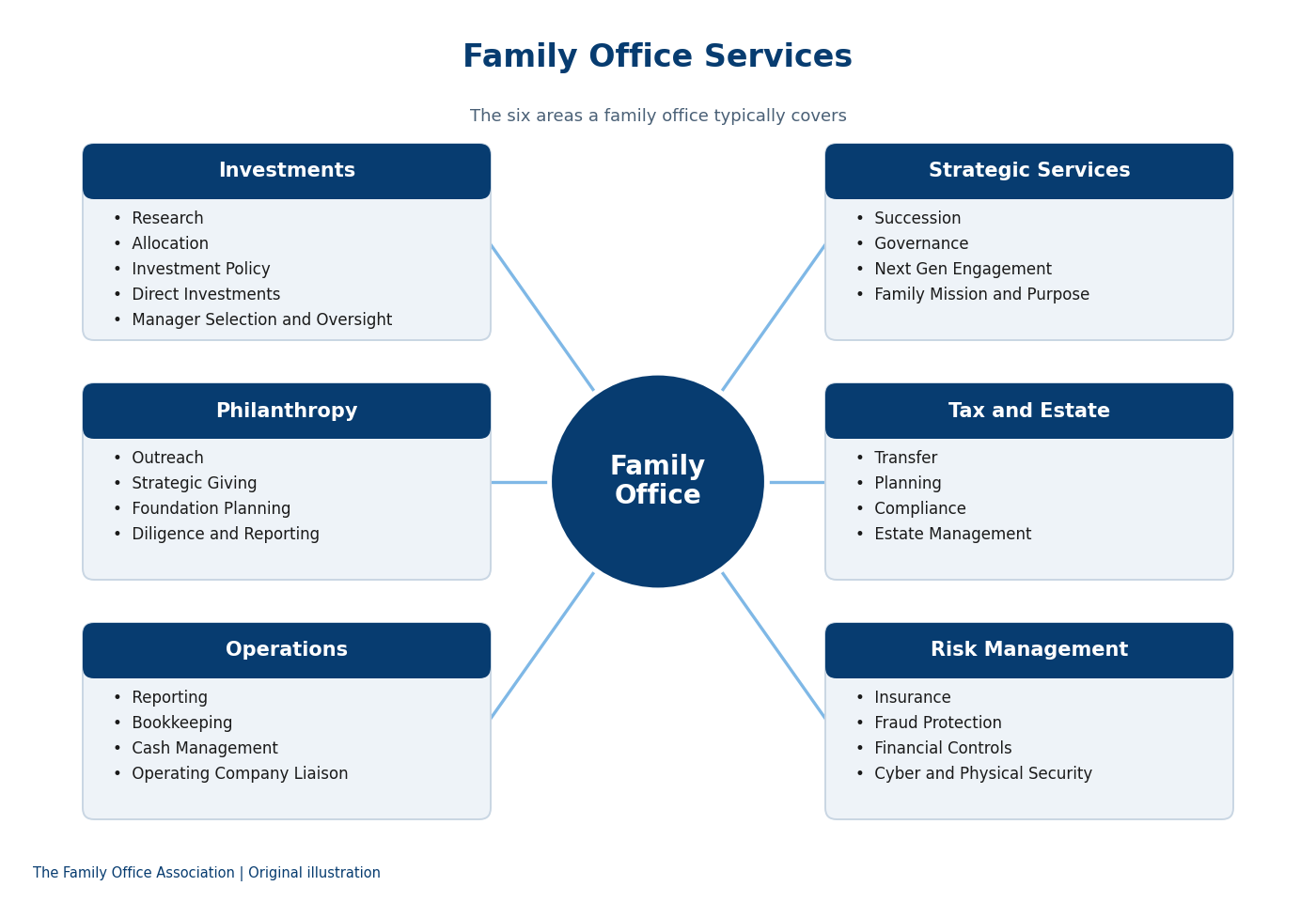
Diagram: the six areas of family office services - investments, strategic services, tax and estate, risk management, operations and philanthropy

Figure 1. The six areas of family office services. Original TFOA illustration.

The literature typically frames MFOs as a stepping stone between traditional wealth management for the mass-affluent and a robust single-family office solution for the ultra-wealthy. We believe the perspective most needed – and often conspicuously absent – is from the perspective of the family itself. What organizational, operational and investment advantages might an MFO offer the family and how can a family identify those traits within an industry that is often opaque by design? This whitepaper offers an analysis of the challenges both families and MFO’s face; as well as a set of practical principles and concepts to help families who are vetting Multi Family Offices for their financial, investment and other needs.

While the landscape of the family office industry is changing, one certainty is that the Multi Family Office space will continue to grow. This is true for a number of reasons, including the changing demographics of wealth, new attitudes toward risk management, and market-based pressures to find new ways to scale the Single Family Office market to a broader segment of the population. While these new vistas are exciting, not every adaptation will be successful. These emerging trends in the family office space make a deeper study into what makes a Multi Family office successful both timely and important. 1

An RIA with a Worse Business Model?

With the rise of more holistic approaches to asset management and legacy planning, the “Multi Family office” concept is often cited as the future for the Wealth Management industry. The term is frequently used to describe a broad range of businesses involved in asset management and investment advisory work as well as a range of non-financial related services that cater to the specific lifestyle needs of wealthy families. The ‘trendiness’ of the MFO moniker from a marketing perspective makes it difficult to identify the core functions of a what an MFO should actually offer its clients. At the risk of being pedantic, a Multi Family office should be “Multi” in that it represents multiple families of significant wealth; and also should serve “families” with a broad range of services focused on non-investment related disciplines, including education and strategy, philanthropy, tax and wealth planning, risk management, finance, operations, and governance.

From the vantage point of a strictly returns-focused investment manager, a Multi Family Office solution typically looks like an RIA with a “worse” business model. “Worse” in this instance refers to the host of activities the MFO offers which may not themselves be revenue or profit producing. This gets at the central tension within the MFO business model and begs the question: “To what extent is their mandate to manage a family’s assets in conflict with their desire to provide a set of non-investment services to help a family define and execute on their legacy?”

The answer to this question falls in part on the MFO to clearly define their service model. But it is also incumbent on the family being served to understand what they’re looking for from an MFO. It should go without saying that if a family is only concerned with identifying the best asset manager(s) for their investments, an MFO is probably not going to be a best fit. There are specialist managers who solely focus on specific investment strategies and asset classes that are more likely to be able to generate consistent ‘alpha’ than a generalist MFO that is managing the complexity of multiple family’s overall asset allocations. One the other hand, if you and your family are beginning to think more broadly about wealth management, especially as it relates to the management of complex trust structures and multigenerational legacy plans, then a Multi Family Office may offer a good balance between the investment management and family office advisory services you need. The important thing is to recognize that, almost by definition, since no firm can be “the best” at everything, by choosing an MFO you are de facto making a compromise. Either you will get great investment performance or great family office services, but it’s unlikely you can get both under one roof at a price that makes sense.

Best Practices and Diligence Considerations

Although the Multi Family Office landscape is changing, the more resilient and time-tested MFOs typically exhibit common characteristics. Ultimately the most important factor to evaluate is their advocacy as a fiduciary for their clients (versus their veracity as asset gatherers). This evaluation includes both the way they demonstrate their ability to act and advise in your best interest, but also their awareness and transparency regarding conflicts of interest (especially when it comes to the services they are financially rewarded or incentivized toward). Taking extra qualitative steps as a fiduciary to flag or avoid conflicts is often what separates the best from the rest. In order to assess the strengths and weaknesses of any particular MFO, we recommend using the following three lenses: 1. Fees; 2. Business Structure and Ownership; and 3. Typical Client Profile.

1. Fees

The most important aspect of an MFOs fee structure is its transparency and alignment. The structure should be completely transparent and easy to understand. There are two common structures: a). AUM Based Fee (typically ~1% p.a.)2 or b). Base Retainer, with an à la carte menu of services that have associated costs.

a). The biggest challenge for the AUM based fee model is twofold: first, the MFO’s ability to balance its desire to increase AUM, by finding new clients, with the necessity to best serve the existing client base. And second, the fact that the MFO is providing non-investment service work under the aegis of an investment service fee structure. This leads to the situation where the MFO looks more like an RIA “with a worse business model,” since AUM fees are directed toward business lines that themselves are not revenue generating (and are essentially loss-leaders for the core investment management service). The biggest strength of the AUM fee model is its simplicity: one fee charged once per year and in turn you have complete access to every service the business offers (and then some). This level of transparency, at its best, can help facilitate a unique kind of bond between the family and the Multi Family Office team, where the family feels comfortable bringing any kind of project or vision to the MFO for discussion and execution.

b). A base retainer plus services menu model solves some of the problems of the AUM model but is not without its own challenges. Chief among these is complexity and the uncapped nature of the potential cost to the family. Service items can be complex and adding a layer of scoping and pricing of projects on a case-by-case basis adds negotiation and deliberation that can slow down operations. From the perspective of behavioral economics, individuals may become deterred from important work simply because they believe the costs are too high, or they can’t get comfortable with the scope of work process. Although this model has the potential to allow a family to specifically tailor services to their needs, it risks a financial barrier between the MFO team and the family, which can extend to matters of trust (especially if the family feels like every problem they raise ultimately leads to a discussion of scope of work and additional cost).

A common way to split the difference between these two models is simply to charge AUM on actively managed assets and then also charge a retainer fee for the broad spectrum of services that the MFO provides. While this blend creates an added layer of complexity, it can help separate out conflicts of interest associated with paying for non-investment services through investment performance. A detailed service level agreement can also help!

2. Business Structure and Ownership

As a general principle, MFOs that are privately owned and operated tend to be more aligned with the needs of their family office clients. Private ownership is important, if only for the fact that public ownership puts shareholder outcomes above all else. The quarterly demand to show growth and profitability to shareholders does not usually align with the long-term design and strategy for families thinking about multi-generational legacy (or even simply a structured philanthropic wind-down process for the founders to give much of their wealth away in their lifetime).

An equally important aspect from a business design perspective is how the office handles sales and client service. The most effective way to manage an AUM model is to separate the Sales division from Client Service division. This division of labor allows the sales team to focus wholly on finding new families that the business can serve, while the client services division can wholly focus on serving the current clients to the best of their abilities. Conflicts of interest emerge when individuals are required to recruit new families while also serving current families. This is not a strict “red flag,” but when evaluating a Multi Family Office that mixes sales with services, take extra time to understand how the business manages this inherent tension. Finally, how does the MFO identify, attract, and retain top talent? Is there a lot of turnover within the client services division and are the current employees happy, efficient and friendly?

MFO’s often emerge out of a particularly successful Single Family Office that is opening up its platform to other families to monetize the investment it has made in technology, talent, and systems. The provenance of an MFO is an important consideration. If the MFO still serves the founding family, how much attention will you get before their needs are serviced? If the MFO was founded initially as a family trust, how will that impact the types of investments you will have access to? Does the structure of the MFO have any implications for tax planning or intergenerational transfers of wealth? These are just some of the many questions you should be asking when considering an MFO to serve your family.

3. Client Profile

Simply put, does your family look like the current roster of families served by the Multi Family Office from the perspective of structural complexity and net worth? While MFO’s may say they deliver the highest level of service equally to all their clients, the pragmatic reality of running a business means that some families will command more time and attention than others. Understanding the workload and coverage demands for those that will work with your family will help you understand this from the perspective of business operations, but it is also helpful to consider this issue on a more absolute basis in terms of what percentage of the business your family would represent in comparison with other client families. And, if the squeaky wheel is going to get more grease, then you may want to consider how that will impact the level of service you can expect from your chosen MFO provider.

Conclusion: Disruption in Private Wealth Management?

The Multi Family Office model continues to evolve and there is an increasing proliferation of business models that appear to be disrupting the traditional Private Wealth Management industry. Virtual Family Offices, Fractional Family Offices, and even exclusive Co-Working Spaces all represent ways the industry is evolving to bring the knowledge and insight of the family office model to more families. However, we recommend you proceed with caution. While the promise of innovation is alluring, it is always important to analyze and understand the fundamentals of a business, especially when that business is your family. Be sure to ask hard questions around MFO structure, conflicts of interest, transparency, fees, service levels, alignment, incentives, and performance. And always keep in mind that no firm can be “the best” at everything, by choosing an MFO you are de facto making a compromise.

Notes

  1. In our whitepaper, “ ?” we make the distinction between “open” and “closed” MFOs. This paper is focused on open MFOs as they are open to bringing on new clients. Closed MFOs are closed to new clients and as such have no business development or sales team.
  2. What is included as a countable asset is important here. In theory, a true MFO will manage all the family’s assets, including a broad spectrum of assets as well as the family’s operating business. Under the AUM model it’s especially important to understand how the fiduciary standards of the MFO align with the family’s desired allocation strategy, which will likely involve both liquid and illiquid investments.

About the Authors

Marc J. Sharpe is the founder and Chairman of TFOA, an organization formed in 2007 to provide a forum for education and networking and to serve as a resource for single family office principals and professionals to share ideas and best practices, pool buying power, leverage talent and conduct due diligence. Mr. Sharpe also teaches an MBA class on “The Entrepreneurial Family Office” as an Adjunct Professor at Rice University and SMU Cox School of Business. Contact: marc@tfoa.me

Seth Morton, Ph.D. has served family offices in areas of investment diligence, execution, and management; governance; research; communications; and multi-generational, sustainable legacy planning. He seeks to improve team performance by cultivating learning-focused and communications-driven processes that deliver exceptional results. He and his family are currently based in Texas.

About TFOA

The Family Office Association (“TFOA”) is a global peer network that serves as the world’s leading single family office community. Our group is for education, networking, selective co-investment, and a resource for single family offices to share ideas, deal flow and best practices. Members are not actively marketing products or services to other members and no contact information or email lists will ever be shared. Since our founding in 2007, TFOA has led the global single family office community by delivering world-class educational content, unique networking opportunities, and exceptional thought leadership to our highly curated network of the world’s largest and wealthiest families: www.tfoa.info

Disclosures

The Family Office Association (“TFOA”) is a peer network of single family offices. Our community is intended to provide members with educational information and a forum in which to exchange information of mutual interest. TFOA does not participate in the offer, sale or distribution of any securities nor does it provide investment advice. Further, TFOA does not provide tax, legal or financial advice. Materials distributed by TFOA are provided for informational purposes only and shall not be construed to be a recommendation to buy or sell securities or a recommendation to retain the services of any investment adviser or other professional adviser. The identification or listing of products, services, links, or other information does not constitute or imply any warranty, endorsement, guaranty, sponsorship, affiliation, or recommendation by TFOA. Any investment decisions you may make based on any information provided by TFOA is your sole responsibility. The TFOA logo and all related product and service names, designs, and slogans are the trademarks or service marks of The Family Office Association. All other product and service marks on materials provided by TFOA are the trademarks of their respective owners. All of the intellectual property rights of TFOA or its contributors remain the property of TFOA or such contributor, as the case may be, such rights may be protected by United States and international laws and none of such rights are transferred to you as a result of such material appearing on the TFOA web site. The information presented by TFOA has been obtained by TFOA from sources it believes are reliable. However, TFOA does not guarantee the accuracy or completeness of any such information. All such information has been prepared and provided solely for general informational purposes and is not intended as user specific advice.

Frequently Asked Questions

What is a multi-family office?

A multi-family office (MFO) is an organization that provides family office-style services — investment management, tax, estate planning, reporting, and family governance — to multiple high-net-worth families simultaneously. By sharing infrastructure across clients, MFOs can offer sophisticated services at a lower cost than a standalone single family office.

When does a multi-family office make more sense than a single family office?

An MFO is typically more appropriate when a family's investable assets are below $100 to $150 million, when the family does not want to manage a professional staff, or when the cost of building a full SFO is not justified by the level of customization required. MFOs are also useful as an interim structure while a family grows toward SFO scale.

What are the disadvantages of a multi-family office?

The primary disadvantages are reduced customization (services are designed for multiple families, not exclusively yours), potential conflicts of interest between clients, less privacy, and the fact that your interests may not always be prioritized. MFOs also typically have less flexibility in accommodating highly specific or unusual investment needs.

How do you evaluate a multi-family office?

Key evaluation criteria include the quality and experience of the investment team, the breadth and depth of services offered, fee transparency, client-to-staff ratios, independence from product sales, regulatory history, and the quality of reporting and technology. Asking for client references and reviewing ADV filings is essential.

Family Office Networks

Clubs & Associations: What would Groucho Marx Do?

Introduction

New and established single family offices are beset on all sides with family office networking opportunities. Most of the self-proclaimed family office networks are run for-profit, with a few notable ‘non-commercial’ exceptions. Some of the networks look like multi-family offices, or loosely affiliated groups of family offices; others are simply trying to cobble together industry-specific conferences or deal platforms. When it comes to the issue of how best to navigate these networking opportunities, we recommend a Marxist approach. Not Karl, but Groucho: “Refuse to join any club that would have [you] as a member.”

Groucho’s self-deprecating criticism of club culture reminds us to always proceed with skepticism and caution. His humorous refrain raises a question about the core intention of any club that is targeting you as their ideal member. This question should always be at the front of one’s mind when considering joining any family office network or community or attending any family office conference.

The world of family offices is growing, but it is still relatively small. While multiple reports have put the number of family offices around the world in 2019 at around 7,300 — which represents about a 38% increase over the last two years — we believe the number of true single family offices to be considerably smaller.1 This small, asset rich, but growing market has seen a precipitous rise over the past five years in the number of networks, clubs, and associations that claim to connect and serve family offices.

Despite the rarity of true single-family offices — especially multi-generational, sustainable family offices, with stewardship across the entire spectrum of a family’s assets and wealth — the family office space has become increasingly filled with ‘everybody and their dog’ claiming to have a family office. Part of the problem is that the term ‘family office’ is used broadly and loosely; and what constitutes a family office for some, may not rise to the same level for others. As a corollary to this increase in the recent preponderance of family offices, there is an associated rise in the number of family office networks, associations, peer groups, and third party service organizations claiming a foothold in the space. The result of all this growth is a feedback loop where more and more high net worth investors claim the status of family office (than probably should) and more and more groups claim to have access to networks of family offices (than probably exist).

When faced with the noisy complexity of this situation, Groucho’s famous quote rings like a bell. Although most wealthy families are used to managing the social and business responsibilities that come with their status, there is a qualitative and quantitative difference with the kinds of groups and organizations that are increasingly clamoring for attention within the single-family office community. Simply put, it is often difficult to differentiate one group from another; and it is becoming increasingly harder to understand the true value proposition for the family offices they claim to serve. At the same time, family offices are increasingly seeking a network of their peers to help them with a host of issues — whether it be a ‘safe’ place to ask questions, to share due diligence, or to pool capital for (no or low fee) co-investment opportunities.

In today’s competitive marketplace, many family offices are looking to deploy their private capital in non-banked, proprietary opportunities; so, the promise of a network of other family offices with whom to co-invest with is highly desirable and very tempting. As family office professionals, it falls to us to understand and evaluate the networks and service providers that are pitching their products, services, and relationship capital. That journey begins with understanding the various business models and alignments (or conflicts) of interest that they entail.

In an effort to provide some clarity, this whitepaper offers an analytical framework to categorize the many groups one might encounter within the family office ecosystem. We suggest that the various business and revenue models they embrace should frame how you think about these groups; more than the service claims they make. With that in mind, we believe three broad business models of family office networks currently exist:2

  • Member-based Models
  • Commission-based Models
  • Advertising-based Models; and

Similar to any private investment opportunity, our overall methodology is to subject these organizations to a certain amount of diligence. In fact, every family office network or partner group should be evaluated like a private equity opportunity. Good diligence begins with a clear vision of the desired outcomes. Like the development of an investment mandate, the family office should create a strategy or mandate for their objectives with these network opportunities. Having a clear idea of what you’re looking for from the family office community you would like to join will make working with these groups much easier and more productive.

Member-based Model (MBM)

Member-based models provide, for a fee, an exclusive network for family office principals (and sometimes also professionals) seeking to learn from one another and stay current on the best-practices in the family office space. When evaluating an organization with a member-based model, one must weigh the exclusivity of the group against the size of the organization. Exclusivity considerations include the quality of the membership, the number of members and how they are organized, and the culture and principles that members abide by. Exclusive membership is fairly easy to evaluate: do they limit membership to single family offices (and perhaps ‘closed’ multi-family offices) only? How do they verify their members? An extremely exclusive group may function more like a small social organization, while a large group with a national presence may function more like a pseudo-industry association. Can they offer the best of both worlds, with local trust and national (or international) reach? Organizations that manage scale and growth through autonomous regional chapters may be able to strike a happy balance between these two ends of the spectrum, so be sure to ask the question!

The issue of group norms, organizational culture, and operating principles speaks to the kind of member participation the group nurtures and encourages. It is important to align your own desired outcomes with the kind of participation the group fosters. The key issue here will turn on matters of privacy, confidentiality, and whether active solicitation is allowed or frowned upon. Organizations can quickly devolve into trading platforms if the main activity becomes simply pitching deals. While this is not necessarily a bad thing — especially if you’re in the market for deals — one consequence of a “deals-focused” association is that the spirit of collaboration and peer-learning usually takes a backseat (and at the extreme the group breaks apart as family office members compete for ‘the best’ deals). In addition, if privacy and confidentiality is not strictly enforced as a core principle of the group, then don’t be surprised if your name and contact details are sold on a list and your family office becomes inundated with calls from a long line of service providers.

Member-based models typically finance their operations through membership fees. Besides keeping the lights on, a reasonable level for dues shows commitment and some skin in the game to the network from members. However, some member-based family office groups charge fees in the tens of thousands of dollars. They aim to be exclusive, but often experience significant turnover as their value quickly diminishes, and family offices are unable to justify the expense. If possible, examine how other peer groups interface with the network. Is there a sizable contingent of family offices that regularly participate in events, or do family offices come and go with limited engagement?

Peer-networks are a special class of member-based groups and deserve particular attention. A true peer network allows family office principals and professionals to interface directly with each other in order to learn from one another and build bonds of friendship and trust. The true test of a peer-network is the peer-group itself. The best peer-groups provide opportunities for principals (and professionals) of family offices to meet in a commercial-free environment. In the best cases, the digital platform, annual or semi-annual meetings, and overall engagement with the network all point to a community with diverse interests and a shared purpose. While there are many peer networks forming, there are only a special few who have survived the test of time and continually add value to their members in a safe and trusted environment.

Commission-based model

Commission-based networks are ‘for-profit’ enterprises that generate income through commissions associated with executing commercial transactions. Like any for-profit business, profit motive determines action, and these groups are incented to sell investments or deals, preferably in volume. In the strictest sense, these groups aren’t really family-office networks, but rather they are sell-side focused businesses or deal platforms. However, it’s important to consider these groups because they often claim to associate with family offices and represent large networks of family office investors. Occasionally, these groups emerge from a profitable family office investment practice. If a family office investment team is growing and building a profitable base, they may seek to register themselves as a broker-dealer and become their own business. While these businesses may offer ancillary services, because of their close connection with family offices, the fundamental relationship they offer is deal-focused and commercial. As their primary interest is in generating transaction or commission-based revenue, it’s best to let your dedicated family office investment team evaluate the viability of the commercial offering before fully committing to any network opportunities.3

One variety of a fee-based model to consider is the multi-family office (MFO), operating as a Registered Investment Advisor (RIA), which typically charges a fee based on assets under management (AUM) and occasionally assets under supervision (AUS). One important distinction to understand and evaluate is whether these groups operate as an ‘open’ or a ‘closed’ MFO. Open MFOs have a core group of family office clients but offer a set of services to any potential client who is willing to pay them a fee. Closed MFOs have a finite set of families that agree to share overhead and pool buying power; and are generally not soliciting for or open to new clients.

Within the spectrum of open/closed MFOs, there is a variety of different kinds of service and/or collaboration models. At one end of the spectrum, an open MFO looks very much like an RIA, perhaps with a few large family office clients that anchor the business. On the other end of the spectrum, a closed MFO may look like a single-family office with a complex structure of sub-organizations, estates, and trusts. From the perspective of evaluating potential partnerships with groups like these, the naming conventions are not as important as the working relationships. One important question to ask yourself when evaluating these groups for your own objectives is whether or not you will be treated as a client or a peer. If the answer is the former, then you’re likely speaking with an open MFO that faces the same incentives and challenges as a typical RIA. If it’s the latter, then you may be dealing with a closed MFO, which has a different set of challenges (which will require a future whitepaper from us at a later time to explore in depth!).

Advertising-based model

Viewed in the context of fee-based models, the advertising-based model appears at first to solve for the issue of mis-aligned profit-motives by generating profits for the family office network, club, or organization through the sale of advertising relevant to the family office ecosystem. As a result, these networks often organize events and engagements that require little financial commitment from a family office. Typically, these family office networking organizations rely on a diverse array of advertisers and sponsors to cover the costs. In the case of large institutions looking to promote a specific area of their business, the organization itself will be its own sponsor — like a private bank or insurance company, for example, hosting an industry-specific conference.

However, to borrow a concept from digital marketing and the tech industry, it’s important to keep in mind that “when the product is free, you are the product”. In other words, these organizations invert the commercial-based model by creating a context where your family office will be “sold” to any commercial interest willing to pay for the lead. We don’t present these relationships in stark terms in order to offer critique, but simply to lay out the fundamental business dynamics that are at work here. Indeed, this model is one of the most common and can produce “win-win” scenarios: single family office professionals gain valuable insights into best practices and new industries, new relationships are forged, and advertisers / service providers may gain important new clients. As in the discussion above, it is always important to understand the motives of the involved parties: what is the objective of the organizers, advertisers, and your fellow participants? And, how do these objectives line up with the objectives of your family office? Special attention should be paid to any data that your family office provides. As we have seen in digital marketing trends, the data generated by users is often more valuable than the product itself.

Final Thoughts

While the number of family offices and family office networks appears complex, our advice for building a peer-network of like-minded single family offices is simple: begin with local and regional groups, consider the underlying business models that drive either profitability (in the case of your commercial enterprise) or mission (in the case of a peer network), and align your organization with groups that share your objectives. When evaluating the merits of any individual organization, seek a diverse array of researched and practiced experts. Ultimately the network that you build is a reflection of your own organization and the mission that is driving your family office. The relationships and goodwill that are forged through these groups can last a lifetime. The task may be daunting, but the rewards can be plentiful. Caveat emptor!

Notes

  1. Mordor Intelligence LLP, https://www.mordorintelligence.com/industry-reports/global-family-offices-industry (2020)Campden Research Report, http://www.campdenwealth.com/article/global-family-office-report-2019 (2019).
  2. Some groups blend these different organizational and revenue-based strategies, but for the sake of simplicity we will limit our discussion to a hypothetically pure version of each network. Of course, when undertaking your own diligence, you should consider the ways in which the family office organization(s) under consideration blend these different approaches and tailor your diligence accordingly.
  3. If their model involves selling securities, a thorough review of the relevant SEC and FINRA documents is in order, especially as it relates to their model and their role as (or relationship to) a licensed broker dealer.

About the Authors

Marc J. Sharpe is the founder and Chairman of TFOA, an organization formed in 2007 to provide a forum for education and networking and to serve as a resource for single family office principals and professionals to share ideas and best practices, pool buying power, leverage talent and conduct due diligence. Mr. Sharpe also teaches an MBA class on “The Entrepreneurial Family Office” as an Adjunct Professor at Rice University and SMU Cox School of Business. Contact: marc@tfoa.me

Seth Morton, Ph.D. has served family offices in areas of investment diligence, execution, and management; governance; research; communications; and multi-generational, sustainable legacy planning. He seeks to improve team performance by cultivating learning-focused and communications-driven processes that deliver exceptional results. He and his family are currently based in Texas.

About TFOA

The Family Office Association (“TFOA”) is a global peer network that serves as the world’s leading single family office community. Our group is for education, networking, selective co-investment, and a resource for single family offices to share ideas, deal flow and best practices. Members are not actively marketing products or services to other members and no contact information or email lists will ever be shared. Since our founding in 2007, TFOA has led the global single family office community by delivering world-class educational content, unique networking opportunities, and exceptional thought leadership to our highly curated network of the world’s largest and wealthiest families: www.tfoa.info

Disclosures

The Family Office Association (“TFOA”) is a peer network of single family offices. Our community is intended to provide members with educational information and a forum in which to exchange information of mutual interest. TFOA does not participate in the offer, sale or distribution of any securities nor does it provide investment advice. Further, TFOA does not provide tax, legal or financial advice. Materials distributed by TFOA are provided for informational purposes only and shall not be construed to be a recommendation to buy or sell securities or a recommendation to retain the services of any investment adviser or other professional adviser. The identification or listing of products, services, links, or other information does not constitute or imply any warranty, endorsement, guaranty, sponsorship, affiliation, or recommendation by TFOA. Any investment decisions you may make based on any information provided by TFOA is your sole responsibility. The TFOA logo and all related product and service names, designs, and slogans are the trademarks or service marks of The Family Office Association. All other product and service marks on materials provided by TFOA are the trademarks of their respective owners. All of the intellectual property rights of TFOA or its contributors remain the property of TFOA or such contributor, as the case may be, such rights may be protected by United States and international laws and none of such rights are transferred to you as a result of such material appearing on the TFOA web site. The information presented by TFOA has been obtained by TFOA from sources it believes are reliable. However, TFOA does not guarantee the accuracy or completeness of any such information. All such information has been prepared and provided solely for general informational purposes and is not intended as user specific advice.

Frequently Asked Questions

What is a family office network?

A family office network is an organization that connects single family offices for the purposes of education, peer exchange, deal flow, co-investment, and knowledge sharing. Networks range from informal alumni groups to formal associations like TFOA to commercially operated platforms that monetize deal flow and introductions.

What are the three business models for family office networks?

The three primary models are: (1) commercial networks that charge fees and generate revenue from deal introductions and sponsored content; (2) membership associations that are fee-funded and member-governed, focused on education and peer connection; and (3) curated peer groups organized around a specific theme, geography, or stage of family office development.

How do family offices use networks for deal flow?

Family offices use networks to share deal opportunities, conduct co-investment due diligence alongside trusted peers, and access deal flow that may not reach traditional channels. The trust established through peer networks is a significant advantage — family offices are more likely to co-invest with known, vetted peers than with unknown counterparts.

What should a family office look for in a peer network?

Key criteria include the quality and commitment of other members (Are they genuine SFOs? Are principals actively engaged?), the non-solicitation culture (Are members selling to each other or genuinely sharing?), the quality of educational programming, and the track record of co-investment activity.

The Family Office Industry

Fact or Fiction?

While family offices come in many shapes and sizes, one universal experience is that everyone working in a family office has at one time heard or said the following platitude: “Once you know one family office, you know one family office.” We term this popular saying “the first law of family offices.” Besides acting as a universal introduction for any family office plenary session, this phrase succinctly distills one of the core truths of family offices: all families, and therefore family offices, are inherently different1. The phrase is more than an empty platitude. In fact, it encapsulates an entire philosophy for family office professionals and therefore merits a more careful reading.

The First & Second Law of Family Offices

The first law of family offices speaks directly to what many people experience when they begin working for a family office: Once you know one family office, you know one family office. Applying any professional expertise to a family office environment is not a simple 1 to 1 equation; it requires a careful consideration of the needs and mission of the family, and these needs are often driven by forces that are not easily captured in a traditional business or MBA curriculum.

If the first law describes the uniqueness and individuality of all families, what we refer to ask the “second law of family offices” speaks to one of the most universal problems experienced by many wealthy families: “Shirtsleeves to shirtsleeves in three generations.” James E. Hughes Jr. has written extensively about the transcultural phenomenon that the vast majority of family wealth disappears within three generations.2 Hughes and others have dedicated their life’s work to understanding the nature of legacy and the methods and approaches to best manage it. This second law captures the generational forces that often impede the legacy and institutionalization of family wealth beyond three generations. Only a very few families and family offices are able to develop legacy structures and systems that enable multiple generations of wealth to build and serve the legacy, mission, and needs of the family and its subsequent generations.

To negotiate the inherit tension between these two laws, something like a “family office industry” has taken shape. In this context, the “industry” refers to a knowledge base of professionals dedicated to helping families navigate complex systems and manage diverse, multi-asset portfolios. In order to better understand how and why these professionals coalesced around this concept of “industry”, we’ll need to dig a little deeper into the first law of family offices: “once you know one family office…”

The ubiquity of this phrase speaks to the way it captures the sheer diversity and broad range of special projects that one encounters while working with or for a family office. It also explains the very reason so many people enjoy family office work: they’re fun, idiosyncratic settings where professionals can build real, long-lasting value in the form of stewardship. Family office work is unique to each family, their background, their mission, their design and their governance. Family offices are typically not structured like a traditional business and the drivers that motivate success are not the same drivers that motivate traditional businesses. Because they are not constrained by traditional corporate drivers, they take on a look and feel that is uniquely tailored to the family itself.

The idiosyncrasies endemic to family offices reveal a deep irony about the first law as it relates to the business of family offices: if it is true that all family offices are different, then it would be impossible to create an industry around a set of principles or standards that define best practice for family offices. Viewed in this way, the phrase undermines the very possibility of a “family office industry”, because industry formation requires repeatable processes and uniformed, predictable outcomes. As a countervailing force, professionals have created a plethora of books, whitepapers, conferences, legal structures, and business processes in an attempt to isolate a standard set of practices that apply across a broad spectrum of family offices3. A tension therefore exists between the first law of family offices and the emergence of a professional class of experts that serve families. But which force is greater, the individual idiosyncrasies of families or the universal professionalization of family office work? It’s only at this nexus that we can begin to understand the term “family office industry”. While it may seem a self-defeating and contrarian position to take, the very concept of the “family office industry” merits careful consideration. What is the term meant to describe, and by whom is the description being made?

Two Family Office Industries: Internal and External

In reflecting on the nature of the word “industry” as it relates to family offices, two emergent categories appear: family offices designed either inside or outside of the family itself. In the modern history of family offices, families like the Morgans, Rockefellers, and DuPonts are held up as early examples of inside family offices. These families created multi-generational institutional administrations to service the management of family members and the legacy of the family. Internal family offices begin exclusively within the family and often draw some initial resources from the principle operating company. The scope of the work at the outset tends to focus around a specific project: designing a multi-generational trust, managing a philanthropic project, or administering a complex, privately owned, asset portfolio. Regardless of the genesis, as family wealth and needs grow over time, the office adapts to the new forms of complexity. It’s these individual growth paths that lead one to the concept of the first law of family offices. In many ways, these internal family offices have the character of a closed system: they are designed purely to manage and administer a set of internal dynamics; their charge is typically not to “grow the business,” but rather to serve the family as they design and implement their legacy.

Family offices that emerge outside of families typically refer to the groups and operating divisions that wealth management companies have created to utilize the language of “family offices” in order to put a container around their largest and most complicated clients. In this sense, “family office industry” describes a particular market segment that private wealth firms find useful for organizing their sales and marketing teams within their own firms. In this way, multi-family offices, private banks, and other wealth management firms attempt to co-opt the language and best practices of successful internal family offices in order to create a product offering for their wealthy customers. Viewed from this perspective, the “family office industry” is simply a segmentation strategy designed to describe a middle ground between institutional and high net worth retail sales and marketing.

These two categories of family offices utilize and rely on each other in different ways. Internal family offices invariably bring in expert advisors who often have developed their expertise in the context of a wealth management firm, trust, risk, or law firm with a particular background with family office clients. Associates, managers, and executives often migrate into external family offices because their unique experiences inside a family office is rare in the marketplace and the skills, understanding, and relationships acquired can be readily leveraged on a larger platform which benefits from broad economies of scale.

The Business of Legacy

The relationship between internal and external family office groups is therefore more symbiotic than parasitic. Thus, it is incorrect to frame the dichotomy in moral terms—it is not the case that one is good and the other is bad—however it is useful to understand these different categories of family office because they speak directly to the schism that exists between the first and second law of family offices. Whereas the internal family office strives to understand and serve the family in accordance with its idiosyncratic and individual features, the external family office seeks to distill universal processes and operations that improve overall efficiency and allow professionals to take skills and experiences from one setting and apply them to a new setting. As a family office principal or professional, you would be well advised to use this framework for your own professional audit and consider how you can best act within the internal and external structure that you inhabit.

If the term “family office industry” persists, then we should use it carefully and with the understanding that family offices are in the business of legacy. And, in our opinion, while many external family offices engage in helping families with defining and executing their legacy, internal family offices are usually more closely in-tune with the family on this issue. Legacy is the key word that sits above the industry. The question of legacy is more aesthetic than mathematical. Some families aspire toward multigenerational legacy models, while others seek to wind down their entire portfolio within one or two generations. There is no formula to tell you what your legacy should be. Instead, careful discussion and consideration with your family, especially the younger generations, should serve as the foundation for the vision of your family’s legacy. From there, advisors can help shape that vision and develop executable plans in order to achieve your vision. Internal family offices excel at designing and implementing legacy plans for the family they serve, but struggle to apply those same systems in different contexts. External offices excel at designing repeatable processes, but they are constrained by their operational demands to fully dedicate themselves to the question of individualized legacy. The most durable and resilient family offices rely on a mix of internal and external features in order to get the most out of each area of strength.

Notes

  1. This principle is not merely an invention of modern marketing, Leo Tolstoy offered his own spin on the phrase in the opening to Anna Karenina: “Every unhappy family is unhappy in its own way.”
  2. James E. Hughes Jr. Family Wealth, Keeping It in the Family: How Family Members and Their Advisers Preserve Human, Intellectual, and Financial Assets for Generations . 2004.
  3. This very whitepaper and the others published by are one such example!

About the Authors

Marc J. Sharpe is the founder and Chairman of TFOA, an organization formed in 2007 to provide a forum for education and networking and to serve as a resource for single family office principals and professionals to share ideas and best practices, pool buying power, leverage talent and conduct due diligence. Mr. Sharpe also teaches an MBA class on “The Entrepreneurial Family Office” as an Adjunct Professor at Rice University and SMU Cox School of Business. Contact: marc@tfoa.me

Seth Morton, Ph.D. has served family offices in areas of investment diligence, execution, and management; governance; research; communications; and multi-generational, sustainable legacy planning. He seeks to improve team performance by cultivating learning-focused and communications-driven processes that deliver exceptional results. He and his family are currently based in Texas.

About TFOA

The Family Office Association (“TFOA”) is a global peer network that serves as the world’s leading single family office community. Our group is for education, networking, selective co-investment, and a resource for single family offices to share ideas, deal flow and best practices. Members are not actively marketing products or services to other members and no contact information or email lists will ever be shared. Since our founding in 2007, TFOA has led the global single family office community by delivering world-class educational content, unique networking opportunities, and exceptional thought leadership to our highly curated network of the world’s largest and wealthiest families: www.tfoa.info

Disclosures

The Family Office Association (“TFOA”) is a peer network of single family offices. Our community is intended to provide members with educational information and a forum in which to exchange information of mutual interest. TFOA does not participate in the offer, sale or distribution of any securities nor does it provide investment advice. Further, TFOA does not provide tax, legal or financial advice. Materials distributed by TFOA are provided for informational purposes only and shall not be construed to be a recommendation to buy or sell securities or a recommendation to retain the services of any investment adviser or other professional adviser. The identification or listing of products, services, links, or other information does not constitute or imply any warranty, endorsement, guaranty, sponsorship, affiliation, or recommendation by TFOA. Any investment decisions you may make based on any information provided by TFOA is your sole responsibility. The TFOA logo and all related product and service names, designs, and slogans are the trademarks or service marks of The Family Office Association. All other product and service marks on materials provided by TFOA are the trademarks of their respective owners. All of the intellectual property rights of TFOA or its contributors remain the property of TFOA or such contributor, as the case may be, such rights may be protected by United States and international laws and none of such rights are transferred to you as a result of such material appearing on the TFOA web site. The information presented by TFOA has been obtained by TFOA from sources it believes are reliable. However, TFOA does not guarantee the accuracy or completeness of any such information. All such information has been prepared and provided solely for general informational purposes and is not intended as user specific advice.

Frequently Asked Questions

How large is the family office industry?

Estimates of total assets managed by family offices globally range from $3 trillion to over $6 trillion, depending on methodology and the definition of a family office. The number of single family offices is estimated at 3,000 to 10,000 globally, with significant concentration in North America, Europe, and Asia.

What is driving growth in the family office industry?

Growth is driven by the rapid expansion of ultra-high-net-worth wealth globally, increasing complexity of family financial situations (private businesses, cross-border assets, next-generation planning), growing distrust of large financial institutions, and the democratization of sophisticated investment strategies that were once limited to institutional investors.

What are the biggest trends reshaping the family office industry?

Key trends include the rise of direct investing and co-investment, increased focus on digital assets and alternative investments, growing sophistication in ESG and impact investing, accelerating technology adoption for reporting and operations, and a generational shift as younger family members take on leadership roles.

Are family offices regulated?

Single family offices are largely exempt from SEC registration in the United States under the Family Office Rule (Rule 202(a)(11)(G)-1 of the Investment Advisers Act). This exemption applies to offices that manage assets only for family members and closely related parties. Multi-family offices are typically registered investment advisers subject to SEC or state regulation.

The Story of TFOA

The Family Office Association you’ve probably never heard of (and how it came to be)…

Introduction

From the outside looking in, The Family Office Association (“TFOA”) is a close-knit network of single family offices, whose combined net-worth rivals that of a sizeable nation-state1. The truth, however, is more nuanced and much more interesting. TFOA was not born of a grand vision, but instead emerged as an unintended consequence of a chance meeting between a small group of single family office executives, who met by chance at the offices of a storied Texas law firm in 2007 to interview a series of eager fund managers and service providers.

Thus, the story of TFOA isn’t like a traditional business case study because TFOA is not a traditional business. This is in part a reflection of the family office construct, which is not in itself a traditional business. A single family office provides information, education, pooled buying power, and wealth management to affluent families, while also preparing the next generation of family leaders and stewards to carry on the family legacy.

While a mind-boggling number of groups have emerged in recent years to capitalize on the craze of family office wealth management, TFOA has put stakeholder experience and long term value above short term monetization. Instead, choosing to focus instead on creating a pure peer network of like-minded family office executives, essentially for free. This is in part due to TFOA’s founding principles of privacy and non-solicitation, but also due to an inherit understanding that when one tries to monetize a network like this, what makes the network valuable, trusted, and special can quickly disappear. Viewed in this light, the story of TFOA provides an important case study into the attendant challenges of conscious capitalism, a movement led by entrepreneurs and business leaders who seek to elevate the human condition through business by orienting business around all attendant stakeholders.

Today TFOA is at an interesting stage. The network continues to grow, and its reach now stretches beyond Texas, including some of the wealthiest families from North America and around the world. Maintaining a commitment to intimate, trusted relationships, while also finding ways to grow and enhance member experience is an ongoing challenge and priority. Looking back on TFOA’s humble beginnings in a conference room in Houston, TX, to becoming one of the preeminent communities for single family offices globally, and charting the possible paths forward, is a unique challenge for any leader who is balancing the value of long-term relationships with the various pressures of engaging a group of diverse and extremely independent stakeholders. Prepare to gain a finer grained understanding of the challenge that face the ultra-wealthy as you read on, because while they are not the same as you and me, rest assured that rich people have problems too.

How it all Started

In early 2007, a small group of single family office executives met in the law offices of Vinson & Elkins, a storied law firm founded in 1917 in Houston, TX. The purpose of the meeting was for the family offices to meet a selection of fund managers and services providers who were targeting the needs of their family office clients. However, the most lasting impact of this meeting was not found in the services being offered, but rather the executives themselves realizing they had much to learn from one another – and that they would much rather meet and discuss these issues in private, out of earshot of the third-party service providers, in a safe and confidential environment.

This meeting highlighted a common problem family offices face. The amount of wealth the family has makes them a target for every service provider, wealth advisor, fund manager, and salesman looking to pitch their wares or sell their services. As the profile of a family office grows, it becomes more and more difficult to find unbiased opinions and independent analysis. Instead, every interaction feels compromised by the bias of a motivated sales representative.

For Marc J. Sharpe, TFOA Founder, and the other family office executives that made up this inaugural group of TFOA founding members, the promise of a community of like-minded peers, who were willing to engage thoughtfully on problems, share best practices and deal flow, and collaborate on matters of diligence, was an idea whose time had come and was too good an opportunity to pass up.

In the early days, TFOA members would meet each month to share interesting opportunities from fund managers, conduct due diligence together in order to capture the wisdom of the crowd, and act as a safe space to discuss challenging problems in a private and confidential setting. Today there is large body of information about family offices, but in 2007 information and best practice were much harder to find. These early meetings carried the group through the Global Financial Crisis, when throughout the fall of 2008, the major financial markets lost more than 30% of their value and the entire financial system was on the brink of collapse. During this time, TFOA members helped each other and provided much needed, impartial counsel as they used their collective expertise and personal networks to monitor the situation and help other members weather the storm.

While surviving the financial crisis showed the inherit value of these relationships, it was the untimely passing of one of the original members of the founding group that strengthened emotional ties and brought members even closer together. This moment of reflection underscored the community’s true priorities: genuine care for all members and the value of human relationships. From these early meetings and experiences through hardships – both economic and personal – TFOA developed its own unique personality, culture, and set of core values. These values guide TFOA to this day and include confidentiality, professionalism, cooperation, non-solicitation, diversity, and trust.

Technology & Expansion

TFOA achieved its next major milestone in 2015, when the group introduced an online portal to facilitate networking and the exchange of ideas outside of physical meetings. While regular, informal gatherings provided tremendous value to family offices looking to build relationships, the locality of the network, and the nature of in-person meetings, placed a ceiling on the potential growth and scale of those relationships. The private, member’s only portal enabled more frequent and instant interactions between meetings, allowing for greater engagement and shared diligence, while also allowing members to connect with other family offices outside of Texas.

Expanding the network also meant redefining the TFOA value proposition with its members. The desire to grow creates an inherent tension and, to be successful, must be done in a way that allows the network to maintain its core values of trust and community while still delivering high quality resources, relationships, and experiences to its members. Members of TFOA are extremely sensitive when it comes to how they are being monetized by others and they are intimately aware of the many self-proclaimed family office network groups that are out there trying to monetize family office relationships in order to profit. The last thing a family office needs is another channel for over-shopped deals and more unwanted solicitation. By being mindful of these issues and pivoting carefully, TFOA was able to continue growing without sacrificing its values or the trusted relationships that exist among and between its members.

The core advantage of having an efficient virtual platform to share ideas, discuss opportunities, and find ways to partner with other members sits within an overall framework that encourages engagement and engenders trust. By keeping members’ needs at the forefront, TFOA has been able to leverage the efficiency of a virtual technology platform without alienating or isolating its member. And by not opening the group to third party service providers and sponsors, or trying to intermediate on deals between members, TFOA has found a path forward that encompasses a space for members to learn and grow together, while also maintaining the ability to accommodate the needs of the network as they evolve in real time.

A Different Kind of Symposium

The challenges around maintaining member privacy and trust and creating outstanding stakeholder experiences was further tested in 2017 with TFOA’s first Annual Single Family Office Symposium. Rather than create an event modeled after a trade conference or marketing event, the Symposium was modeled after the Symposia of ancient Greece and their more modern iterations found in universities and other institutions of higher learning throughout the world.

The first ever symposium, as documented in Plato’s dialogue The Symposium, brought together a broad range of Athenian personalities including poets, playwrights, philosophers, politicians, war veterans, businessmen, and landowners. Though disparate in background and perspective, they came together to learn from each other and to share ideas. The objective was not to conform each participant into a single dogma, but rather to facilitate growth and learning for each individual in accordance with their own needs and interests.

TFOA’s Symposium was similarly designed, pairing the candor of the original symposium with the discretion of Chatham House Rules. By partnering with The Baker Institute, the first TFOA symposium was able to bring together speakers with a combination of public policy as well as practical investing experience. This also helped keep the focus of the gathering on mutual learning, rather than on marketing or business development. This first symposium included no sponsors, no service providers, nor any non-single family office attendees. Over 100 principals and “c-level’ single family office participants attended, as well as a high powered roster of speakers. The first symposium set a high bar for future events and also acted as a practical manifestation of the organization’s values in action.

TFOA has now successfully hosted its annual symposium every year since 2015 and has brought members together for these annual gatherings in Houston, Dallas, Austin, and virtually (during the coronavirus pandemic). While each symposium has retained its closed door nature and strict guest list policy, over time the format has involved to include a select group of sponsors who are willing to underwrite some of the hard costs of hosting such an event. The participation of non-family office attendees presents unique challenges. On the one hand, family offices prefer not to participate in an event that is merely a promotional grab bag where they will be inundated by service providers and fund managers. On the other hand, sponsors need a meaningful return on investment for their participation. Managing this inherent tension takes careful curation and management. By finding firms that understand the long-term value proposition that a network like TFOA represents, and also keeping the overall ratio of sponsors low, in order to provide real opportunity for relationships to emerge, TFOA has been able to provide an outstanding experience for all stakeholders while keeping the symposium firmly rooted within its core values. Today, TFOA’s annual symposium continues to be unlike any other business conference or networking event. Instead, it remains an intimate gathering of family offices for relationship building and learning, supported by a select group of aligned stakeholders focused on long-term relationships and trust.

Looking to The Future

Despite the many challenges of the coronavirus pandemic in 2020, TFOA has continued to grow and adapt. Virtual meetings further extended the reach of the network and events now include both a virtual and in-person component for members, wherever they may be based. As TFOA’s membership base continues to grow and diversify, today over half of all members reside outside Texas. It is a long way from the halcyon days where ten members would gather and share deal flow and ideas with each other around a coffee table at Kenny & Ziggy’s diner in the Houston Galleria area. However, the same core issues remain the same, but greater scale creates its own pressures and challenges.

Tomorrow’s TFOA will retain many of the things that have made TFOA successful to date but will continue to grow and add high quality family office relationships around the world. Through a distributed network model, family offices will be able to build their own local TFOA communities in line with TFOA’s core values and servant-leader mindset. And with new growth means new opportunities to serve the network. It remains to be seen what this means for each of the stakeholders who make up the complex family office eco-system that is TFOA, but one thing is certain, TFOA’s leadership has learned that as long as your core values are at the center of everything you do, every day, then there is no challenge that cannot be met and overcome.

Notes

  1. The modern family office traces its roots to the Morgans and the Rockefellers; two early 20th century families that built sophisticated administrative and management systems to manage their estates across multiple generations. More recently family offices have been in the news as society becomes increasingly concerned (and polarized) around the wealth gap.

About the Author

Marc J. Sharpe is the founder and Chairman of TFOA, an organization formed in 2007 to provide a forum for education and networking and to serve as a resource for single family office principals and professionals to share ideas and best practices, pool buying power, leverage talent and conduct due diligence. Mr. Sharpe also teaches an MBA class on “The Entrepreneurial Family Office” as an Adjunct Professor at Rice University and SMU Cox School of Business. Contact: marc@tfoa.me

About TFOA

The Family Office Association (“TFOA”) is a global peer network that serves as the world’s leading single family office community. Our group is for education, networking, selective co-investment, and a resource for single family offices to share ideas, deal flow and best practices. Members are not actively marketing products or services to other members and no contact information or email lists will ever be shared. Since our founding in 2007, TFOA has led the global single family office community by delivering world-class educational content, unique networking opportunities, and exceptional thought leadership to our highly curated network of the world’s largest and wealthiest families: www.tfoa.info

Disclosures

The Family Office Association (“TFOA”) is a peer network of single family offices. Our community is intended to provide members with educational information and a forum in which to exchange information of mutual interest. TFOA does not participate in the offer, sale or distribution of any securities nor does it provide investment advice. Further, TFOA does not provide tax, legal or financial advice. Materials distributed by TFOA are provided for informational purposes only and shall not be construed to be a recommendation to buy or sell securities or a recommendation to retain the services of any investment adviser or other professional adviser. The identification or listing of products, services, links, or other information does not constitute or imply any warranty, endorsement, guaranty, sponsorship, affiliation, or recommendation by TFOA. Any investment decisions you may make based on any information provided by TFOA is your sole responsibility. The TFOA logo and all related product and service names, designs, and slogans are the trademarks or service marks of The Family Office Association. All other product and service marks on materials provided by TFOA are the trademarks of their respective owners. All of the intellectual property rights of TFOA or its contributors remain the property of TFOA or such contributor, as the case may be, such rights may be protected by United States and international laws and none of such rights are transferred to you as a result of such material appearing on the TFOA web site. The information presented by TFOA has been obtained by TFOA from sources it believes are reliable. However, TFOA does not guarantee the accuracy or completeness of any such information. All such information has been prepared and provided solely for general informational purposes and is not intended as user specific advice.

Frequently Asked Questions

When was TFOA founded and what was the original mission?

TFOA (The Family Office Association) was founded in 2007 by Marc J. Sharpe with the mission of creating a trusted, non-commercial peer community for single family office principals and professionals. The founding insight was that SFO leaders lacked a private, unbiased forum to share ideas, best practices, and deal flow — free from the conflicts of interest inherent in commercially sponsored family office events.

How has TFOA grown since its founding?

Since 2007, TFOA has grown from a small, Houston-based network into a global community of some of the world's largest and wealthiest single family offices. The organization has expanded its educational programming, hosted annual symposiums across the United States, and built a library of whitepapers and research that has become a leading resource for the SFO community.

What makes TFOA different from other family office organizations?

TFOA's defining characteristics are its strict non-solicitation culture (members may not market products or services to other members), its curation of genuine single family offices (no service providers or wealth managers as primary members), its principal-level engagement, and its commitment to confidentiality. These principles create the trust that makes TFOA's peer network uniquely valuable.

What educational resources has TFOA developed for the family office community?

TFOA has developed an extensive library of original whitepapers covering every dimension of family office structure, operations, and investing — from governance and staffing to direct investing, digital assets, and emerging investment themes. TFOA also produces podcasts, videos, and an annual symposium curriculum in partnership with leading business schools including SMU Cox School of Business.