
Why Higher Needs Bring Harder Problems, and What That Means for Families of Wealth
Abstract
Maslow’s hierarchy of needs is usually drawn as a pyramid, with physiological needs at the base and self-actualization at the apex. This paper proposes a companion figure, an inverted pyramid called Sharpe’s hierarchy of problems. Its premise is that as needs ascend the hierarchy, the problems attached to them become progressively harder to define, measure and solve. Hunger has a known solution and a natural stopping point; self-actualization has neither. Drawing on Maslow’s original writing, later empirical tests of need theory, the literature on ill-structured and “wicked” problems, and research on money and well-being, the paper sets out four dimensions along which problem difficulty rises with the level of need: definability, measurability, purchasability and the absence of a stopping rule. It insists that basic needs come first and that their deprivation is the more urgent suffering; the claim is about the shape of problems, not a ranking of hardship. It then applies the framework to ultra-wealthy families, for whom money has largely solved the lower levels and whose central concerns, such as stewardship of wealth, raising productive next generations, deciding whom to trust and finding purpose, sit near the top of the hierarchy, where money is least effective. It closes with practical implications for families and family offices, the limitations of the framework, and propositions that future research could test.
Nothing in this white paper constitutes psychological, medical, legal, tax, investment or accounting advice. The discussion of human needs, well-being and family wealth is a general educational summary only, and individual circumstances differ. Readers should consult their own qualified advisers, including licensed mental-health professionals where appropriate, before acting on anything described herein, and should not rely on this white paper as a substitute for such advice.
Introduction
Few ideas from psychology are as widely recognized as Abraham Maslow’s hierarchy of needs. In its familiar form it is a pyramid: physiological needs at the base, then safety, love and belonging, esteem, and self-actualization at the apex. The image is intuitive because it matches common experience. A person who is starving thinks about food, not about whether his work is meaningful.
This paper begins from a simple observation about that pyramid. It describes what people need, but it says little about what kind of problem each need presents. The problems are not alike. The problem of hunger is concrete: the goal is clear, the remedy is known, progress can be measured, and the need is satisfied when the meal is eaten. The problem of self-actualization is of a different order. No one can say with confidence what its solution is for a particular person, whether it has been reached, or when the work is finished. Nor can anyone simply provide it to someone else.
The proposal is therefore to draw a second pyramid alongside Maslow’s, inverted, and to call it Sharpe’s hierarchy of problems. Where Maslow’s pyramid is broadest at the base, reflecting the primacy and universality of basic needs, the hierarchy of problems is broadest at the top, reflecting the growing difficulty of defining and solving the problems that higher needs bring. The two figures are meant to be read together (Figure 1).
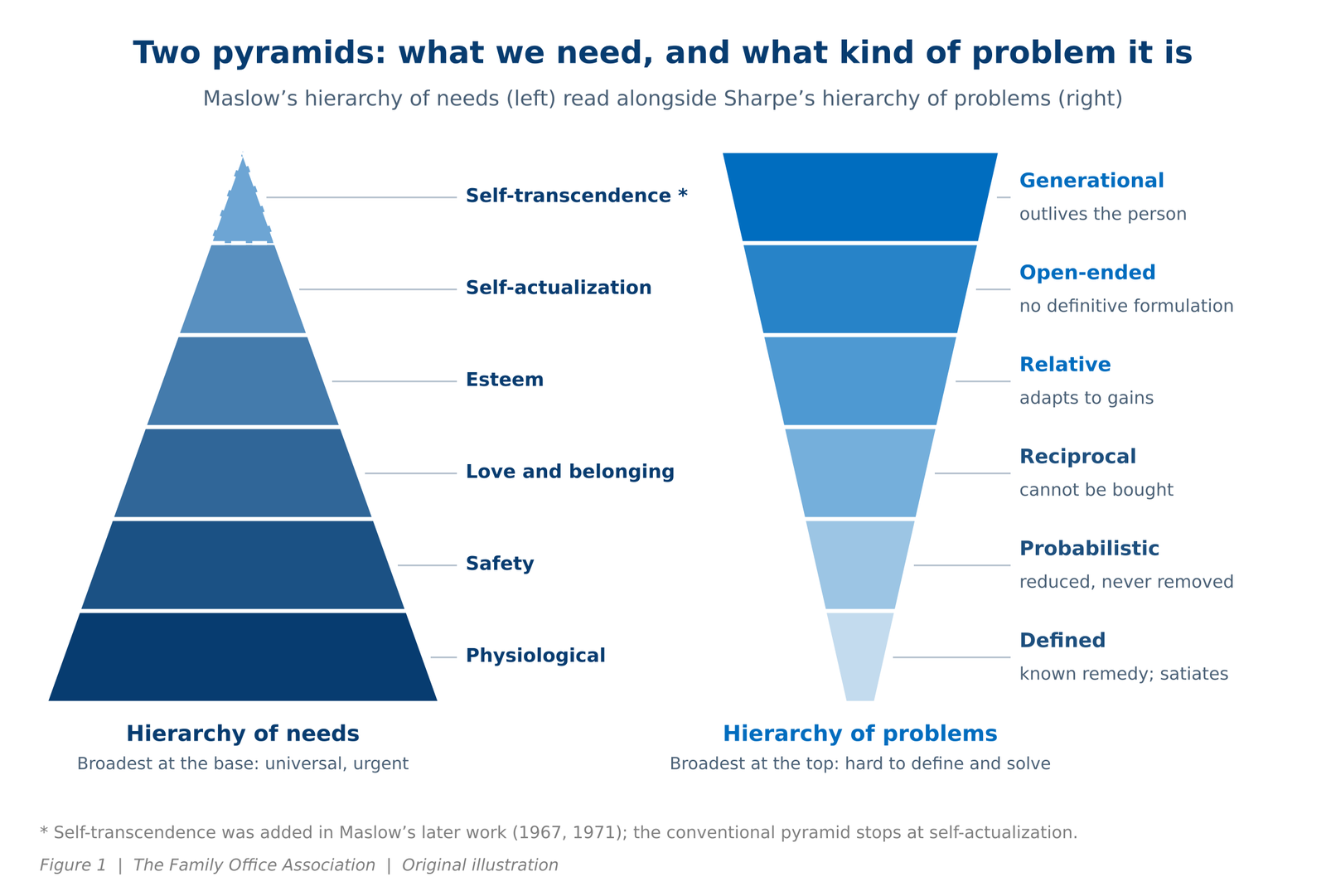
Figure 1. Maslow’s hierarchy of needs, as conventionally drawn, and Sharpe’s hierarchy of problems. Moving up, needs become less universal and less urgent, while the problems attached to them become harder to define, measure and solve. Original TFOA illustration.
Two clarifications frame everything that follows. First, the framework does not minimize basic needs. They come first, they are the more urgent, and their deprivation is the greater suffering. A problem can be easy to define and still be desperately hard to solve for someone without money, work or safety. Second, the framework is conceptual. It organizes existing research into a new figure and states propositions that could be tested; it does not report a new study.
The framework has particular force for families of significant wealth. Money is extraordinarily good at solving the problems at the base of the hierarchy and markedly less good at solving those at the top. Families for whom the lower levels are secure tend to find that their most persistent concerns, such as stewarding wealth across generations, raising capable and motivated children, knowing whom to trust and finding a purpose for the fortune, sit precisely where problems are hardest to define. The later sections of the paper apply the framework to those concerns.
Maslow’s Hierarchy, as Maslow Wrote It
Maslow (1943) proposed that human motivation is organized around five sets of basic needs: physiological, safety, love, esteem and self-actualization. The organizing principle was prepotency: when a lower need is unmet it dominates behavior, and when it is reasonably satisfied, higher needs emerge. His own formulation was memorable: “It is quite true that man lives by bread alone — when there is no bread” (p. 375).
Three features of the original are often lost in the popular version, and each matters for this paper. First, Maslow did not intend a rigid staircase. He warned against the impression that one need must be satisfied completely before the next appears, and offered an illustration of how partially satisfied the average person’s needs might be: perhaps 85 per cent of physiological needs, 70 per cent of safety needs, 50 per cent of love needs, 40 per cent of esteem needs and 10 per cent of self-actualization needs (p. 389). The numbers were illustrative, not measured, but their shape is telling. Even in Maslow’s own example, the higher the need, the less of it is met (Figure 2).
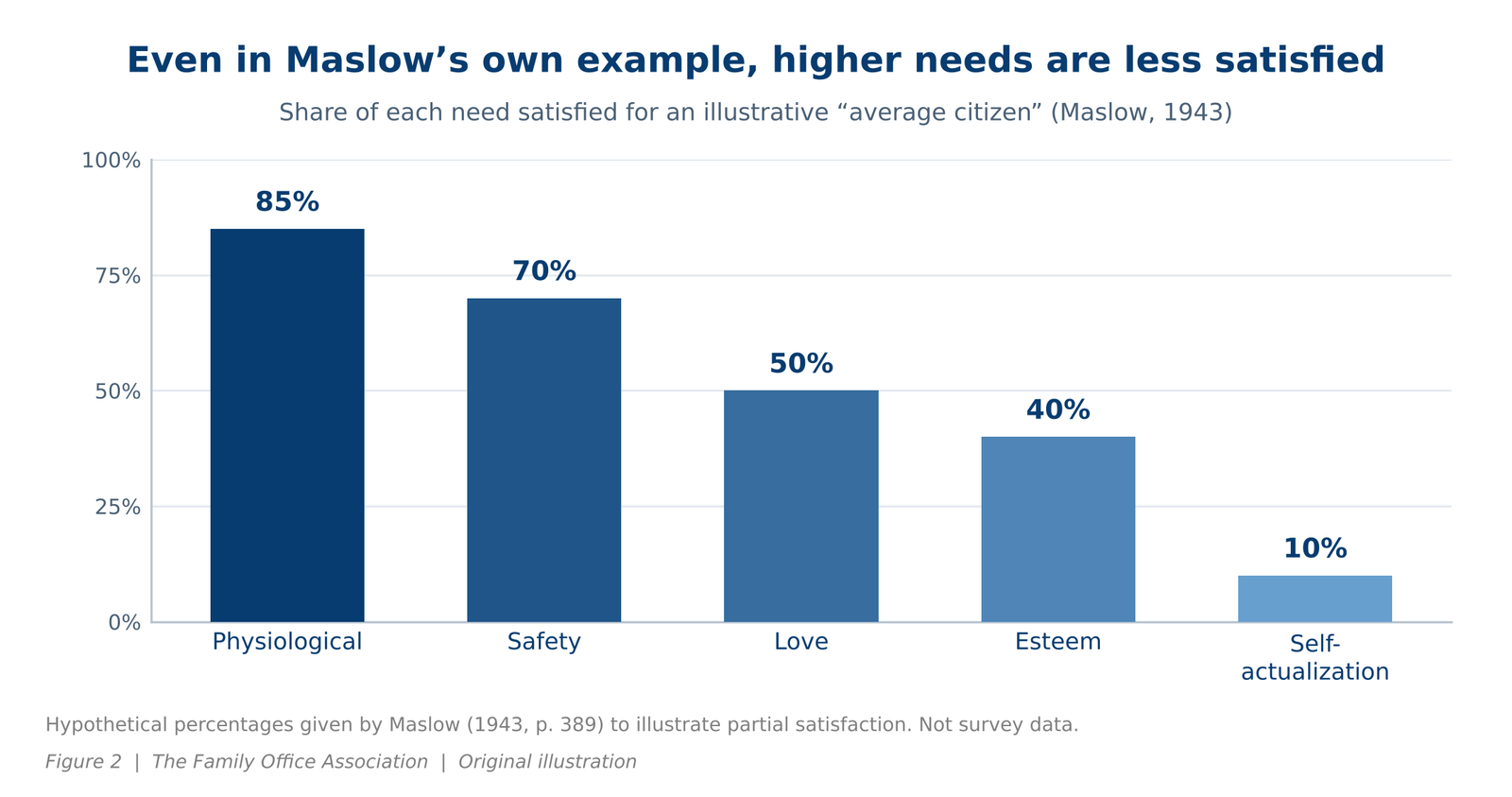
Figure 2. Maslow’s illustration of how far an average person’s needs are satisfied, by level. The percentages are Maslow’s own hypothetical example (1943, p. 389), not survey data. Original TFOA illustration.
Second, Maslow defined self-actualization in deliberately open terms, as the desire to become what one is capable of becoming: “What a man can be, he must be” (p. 382). He added that the specific form this takes “will of course vary greatly from person to person” (p. 383). The top of the hierarchy is, by its author’s own account, the level with the least common definition.
Third, Maslow did not draw a pyramid. Bridgman et al. (2019), after searching his published work and archives, found no trace of him presenting the hierarchy in that form. The pyramid they identified as probably the earliest appeared in a 1960 management article by the consulting psychologist Charles McDermid (1960). Late in his life Maslow also extended his thinking beyond self-actualization, toward what he called the “farther reaches” of human nature and toward motives that transcend the self (Maslow, 1967, 1971). Koltko-Rivera (2006) reconstructs from those later writings a version with self-transcendence above self-actualization, and argues that the conventional five-level account misdescribes Maslow’s later thought; Maslow himself never published a six-level diagram. The inverted pyramid proposed here is therefore a companion to a popular image rather than to a diagram Maslow endorsed, and it is drawn with the later, six-level version in mind. Others have inverted the pyramid informally for different purposes, for example to place meaning at the base (Nielsen, 2016) or to depict the shadow side of each need (Sheridan, 2023); the use here, to describe how the character of problems changes with the level of need, is distinct from those.
What the evidence says about the hierarchy
Empirical support for a strict hierarchy has always been modest. An early review of factor-analytic, ranking and longitudinal studies found only partial support for the idea of a need hierarchy, and no support from the longitudinal studies (Wahba & Bridwell, 1976). The most comprehensive modern test, using Gallup World Poll data on 60,865 respondents in 123 countries, found that needs tend to be fulfilled in a broadly consistent order, but only loosely, and that the fulfilment of basic and safety needs depended in part on the country (Tay & Diener, 2011). In that study, life evaluation was most strongly associated with meeting basic needs, while positive feelings were most strongly associated with social and respect needs, and the effects of different needs on well-being were largely independent of one another. From an evolutionary perspective, Kenrick et al. (2010) proposed a renovated hierarchy of overlapping motives in which earlier needs are not abandoned when later ones emerge, and in which self-actualization is removed from the apex, treated as largely subsumed within esteem and mating motives, and the top is given to mate acquisition, mate retention and parenting. That is a direct challenge to the top of the conventional pyramid, and a reminder that the upper levels are the most contested part of the theory.
Two conclusions follow for this paper. The ordering of needs is best treated as a description of priority under scarcity, not as a ladder that must be climbed rung by rung. And higher needs matter for well-being in their own right, whether or not lower needs are fully met. Both points support reading Maslow’s pyramid alongside a second figure that describes the problems each level presents.
What Makes a Problem Hard to Define
The hierarchy of problems borrows its vocabulary from research on problem structure. Reitman (1964) distinguished well-defined problems, whose starting state, goal and permissible moves are specified, from ill-defined problems, in which one or more of those elements is open. Simon (1973) developed the distinction into well-structured and ill-structured problems, observing that the boundary between them is vague and that much real-world problem solving takes place on the ill-structured side.
In the same year Rittel and Webber (1973), writing about social planning, set out the characteristics of what they called wicked problems: problems that resist definitive formulation. Among the characteristics they listed, five are directly relevant here: a wicked problem has no definitive formulation; it has no stopping rule; its solutions are better or worse rather than true or false; there is no immediate or ultimate test of a solution; and every attempt at a solution has consequences that cannot be undone. Tame problems, by contrast, can be specified, solved and checked.
Grint (2005) linked these problem types to forms of authority. Tame problems call for management, the application of a known process. Wicked problems call for leadership, whose task is to “ask the right questions rather than provide the right answers” (p. 1473). Critical problems, in a crisis, call for command. The distinction matters because institutions built to manage tame problems tend to misfire when they treat wicked problems as tame ones.
From this literature the paper draws four dimensions on which problems can be compared across the levels of the hierarchy:
- Definability. Is the goal state clear, and would the people involved agree on it?
- Measurability. Is there reliable, timely feedback on whether the problem is being solved?
- Purchasability. Can the solution be bought, or delegated to someone else to provide?
- Stopping rule. Does satisfaction arrive, so that the problem is finished for now, or does the problem stay open?
Table 1 summarizes how each level of Maslow’s hierarchy scores on these dimensions. The ratings are qualitative judgments drawn from the arguments in this paper, offered as propositions rather than measurements, and Figure 3 restates them visually rather than testing them. One scope condition should be explicit: purchasability depends on resources, so the ratings describe a person or family with the means to act on the lower levels. For someone without those means, the base of the pyramid is not easy at all.
Table 1. The four dimensions of problem difficulty, by level of need
| Level of need | Definability | Measurability | Purchasability | Stopping rule | Typical problem |
|---|---|---|---|---|---|
| Physiological | High | High | High | Yes: satiation | Secure food, water, shelter, sleep |
| Safety | High to moderate | Moderate (probabilistic) | High to moderate | Weak: “enough” is elastic | Reduce risk to person, health and assets |
| Love and belonging | Moderate | Low (ambiguous signals) | Low | No | Form and keep relationships that are not transactional |
| Esteem | Moderate to low | Low (relative, adaptive) | Low | No | Earn respect and self-respect that feel deserved |
| Self-actualization | Low | Very low | Very low | No | Become what one is capable of becoming |
| Self-transcendence | Very low | Very low | Very low | No | Serve purposes beyond the self, across generations |
Ratings are the author’s qualitative propositions, not measured values. Self-transcendence follows Maslow’s later work (1967, 1971) as discussed by Koltko-Rivera (2006).
Sharpe’s Hierarchy of Problems
The central proposition can now be stated. As needs ascend Maslow’s hierarchy, the problems they present become less definable, less measurable, less purchasable and less likely to have a stopping rule. The inverted pyramid represents this growth in difficulty: narrow at the base, where problems are concrete, and broad at the top, where they are open-ended. Each level is taken in turn below.
Physiological needs: defined problems, known solutions
Hunger, thirst and exposure are the clearest problems a person can face. The goal is obvious, the remedy is known, progress is visible within hours, and the need subsides when it is met. None of this makes them easy to solve for someone who lacks the means, and for much of the world’s population they remain the problems that dominate life. In Tay and Diener’s (2011) global data, meeting basic needs was the strongest correlate of how people evaluate their lives. For an individual or family with the means to act, these problems are well-structured in Simon’s sense: what is missing is resources, not a definition. At the scale of a community or a society the picture is different. Rittel and Webber’s own examples of wicked problems included poverty and crime, and chronic illness or addiction can make even an individual’s basic needs hard to meet. The framework describes the problems a person or family faces at each level, not the policy problem of meeting those needs for everyone.
Safety: defined problems, probabilistic solutions
Safety problems remain largely definable and purchasable: locks, insurance, savings, health care and diversified assets all reduce risk. What changes is that the solution is now probabilistic and the stopping rule weakens. There is no amount of security that removes all risk, and the sense of having enough is elastic. A survey of wealthy households by Boston College’s Center on Wealth and Philanthropy, reported by Wood (2011), covered 165 households, 120 of them with at least $25 million in assets, with an average net worth across respondents of about $78 million. Many respondents nevertheless said they did not feel fully financially secure, and on average said they would need about a quarter more wealth to do so. The survey was reported in journalism rather than in a peer-reviewed study, but its pattern is consistent with the weak stopping rule described here.
Love and belonging: problems that money cannot buy
At the third level the problem changes character. Belonging cannot be bought or delegated, because its value depends on being freely given. Feedback becomes ambiguous: it is hard to know why someone is a friend, and harder still when one is wealthy. Self-determination theory identifies relatedness, alongside autonomy and competence, as a basic psychological need whose satisfaction supports well-being and intrinsic motivation (Ryan & Deci, 2000). That theory does not rank its three needs, so it supports the point about the character of the problem rather than Maslow’s ordering. Relatedness is not a commodity, and no stopping rule applies to it.
Esteem: relative problems that adapt
Esteem needs are partly relative and partly self-referential. External esteem depends on comparison with others; internal esteem depends on believing that respect is deserved. Both are subject to adaptation. In a small study, Brickman et al. (1978) found that 22 lottery winners were not significantly happier than a comparison group, consistent with the idea that people adjust to gains. Among millionaires, those who earned their wealth were moderately happier than those who inherited it, holding total wealth constant (Donnelly et al., 2018). That study did not measure esteem, but a plausible reading is that the source of a position, not only its size, shapes the self-respect it confers.
Self-actualization: problems without a definitive formulation
Self-actualization meets almost every criterion of a wicked problem. It has no definitive formulation, because Maslow defined it by reference to each person’s own potential. It has no stopping rule. Its outcomes are better or worse rather than right or wrong, and there is no conclusive test of success. Measurement is possible but recent: Kaufman (2023) developed a 30-item scale measuring ten characteristics of self-actualizing people, including purpose, authenticity and a creative spirit, and found them correlated with well-being but only weakly correlated with recent income (r = .09) and not significantly with education. People are also poor guides to what will fulfil them. Research on affective forecasting shows that people systematically overestimate how intensely and for how long future events will affect them (Wilson & Gilbert, 2005), which makes it hard to choose the goals whose attainment would actually satisfy.
Self-transcendence: problems that outlive the person
Maslow’s later work placed motives that reach beyond the self, such as service to a cause, to others or to future generations, above self-actualization (Koltko-Rivera, 2006; Maslow, 1971). Problems at this level have the longest time horizons and the slowest feedback. Whether a family’s philanthropy has done lasting good, or whether its values have been passed on, may not be knowable within the lifetime of the people who made the decisions.
Figure 3 summarizes the argument. As the level of need rises, the share of the problem that money and expertise can solve directly falls, and the share that depends on judgment, relationships and time rises.
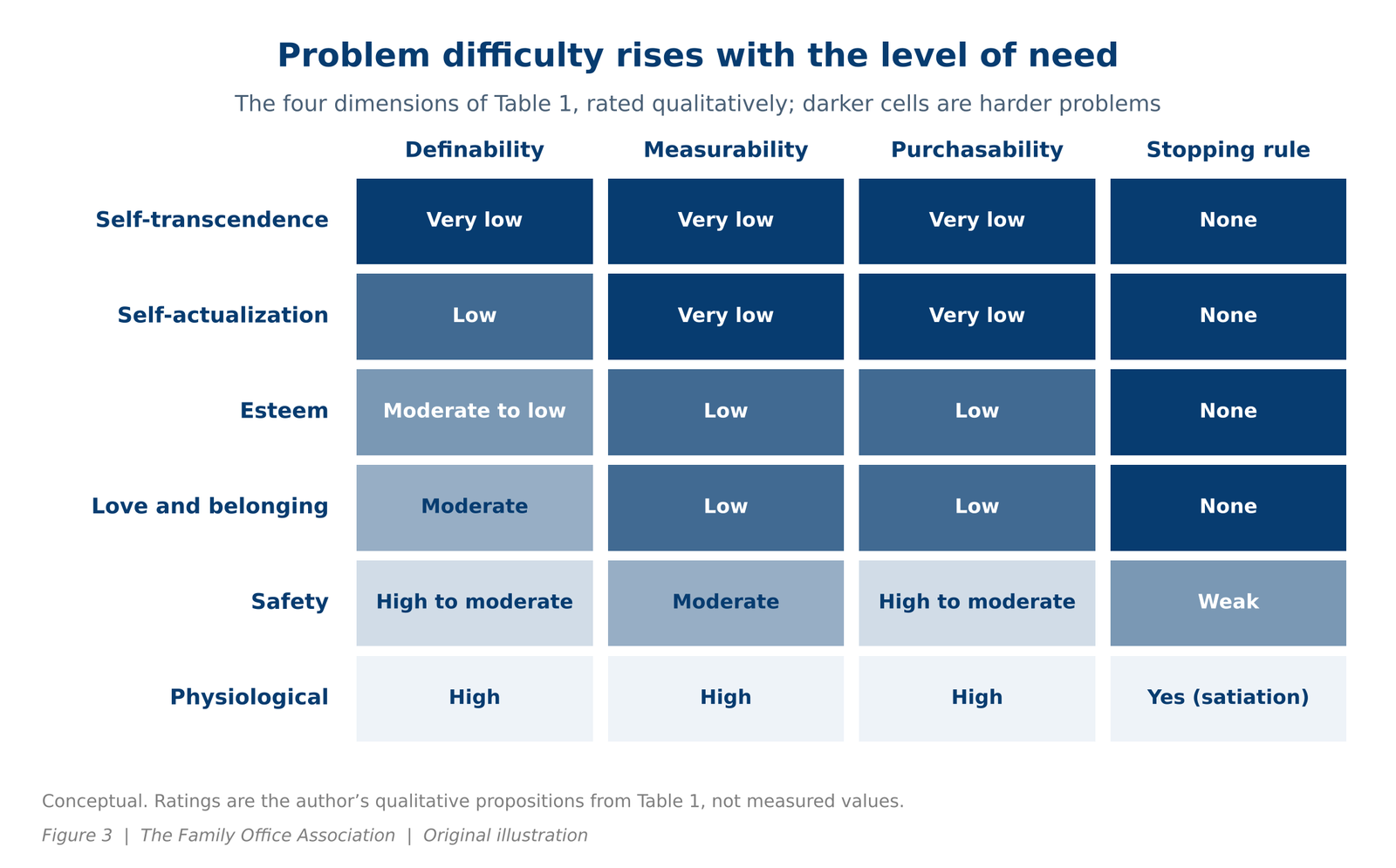
Figure 3. The four dimensions of problem difficulty across the six levels of need, using the qualitative ratings in Table 1. Darker cells indicate harder problems. Conceptual illustration, not measured data. Original TFOA illustration.
A Necessary Caveat: Basic Needs Come First
It would be a serious misreading of the framework to conclude that problems at the top of the hierarchy are more important, or more painful, than those at the base. The hierarchy of problems is not a hierarchy of suffering. Deprivation of food, shelter or safety is more urgent than any problem of meaning, and it is prepotent in exactly Maslow’s sense: it crowds out every other concern.
The research on income and well-being makes the same point. Kahneman and Deaton (2010) found that higher income improves people’s evaluation of their lives, while its association with day-to-day emotional well-being appeared to level off at an annual income of about $75,000. A later adversarial collaboration found that for most people, happiness continues to rise with the logarithm of income, while the least happy minority shows a plateau (Killingsworth et al., 2023). A logarithmic relationship means that each additional dollar matters most to those who have least. Money solves the problems at the base of the pyramid powerfully, and it should.
Seen this way, harder problems at the top are a kind of privilege: the problems of people whose more urgent ones have been solved. Keynes (1930/1931) anticipated this. If the economic problem were ever solved, he wrote, “for the first time since his creation man will be faced with his real, his permanent problem”: how to use his freedom from pressing economic cares “to live wisely and agreeably and well” (p. 367). The inverted pyramid describes that permanent problem.
Why Wealth Does Not Climb the Inverted Pyramid
If money solves the base of the hierarchy so well, why does it do so little at the top? The literature offers several converging answers.
Money works on purchasable problems. At the lower levels, solutions can be bought: food, housing, security and care. At the higher levels the solutions are relationships, competence, autonomy and meaning, which must be built, earned or freely given. Herzberg et al. (1959) made a parallel distinction in the workplace between hygiene factors, such as pay and working conditions, whose absence causes dissatisfaction, and motivators, such as achievement and responsibility, which produce satisfaction. The two-factor theory has a mixed replication record, but its central intuition fits this paper: pay can remove a grievance but cannot supply a purpose.
Gains at the top are small and conditional. Among more than 4,000 millionaires, greater wealth was associated with greater happiness only at high levels, above about $8 million to $10 million across two samples, and the differences were modest (Donnelly et al., 2018). People for whom financial success is a central life aspiration report lower well-being than those whose central aspirations are intrinsic, such as relationships and personal growth (Kasser & Ryan, 1993).
Unmet higher needs produce their own distress. Maslow (1967) argued that self-actualizing people, whose basic needs are met, are motivated by higher values such as truth, goodness, beauty and justice, and that the frustration of these metaneeds produces what he called metapathologies: disorders of value and meaning rather than of the body. In the language of this paper, the problems at the top do not disappear when they go unsolved; they resurface as dissatisfaction that money does not cure.
Wealth adds problems of its own. The Boston College respondents described relationships altered by money, fears that large inheritances would harm their children, and a sense of having lost the right to complain (Wood, 2011). These are concerns of belonging, esteem and purpose, and they are created or intensified by wealth rather than relieved by it.
The Hierarchy of Problems in the Wealthy Family
For a family of significant wealth, the framework suggests a reordering of attention. The lower levels are, for practical purposes, secured, and the family office exists in large part to keep them secure. The concerns that remain, and that families most often bring to their peers, cluster at the upper levels. Figure 4 places them on the hierarchy and shows which are tame problems and which are wicked ones.
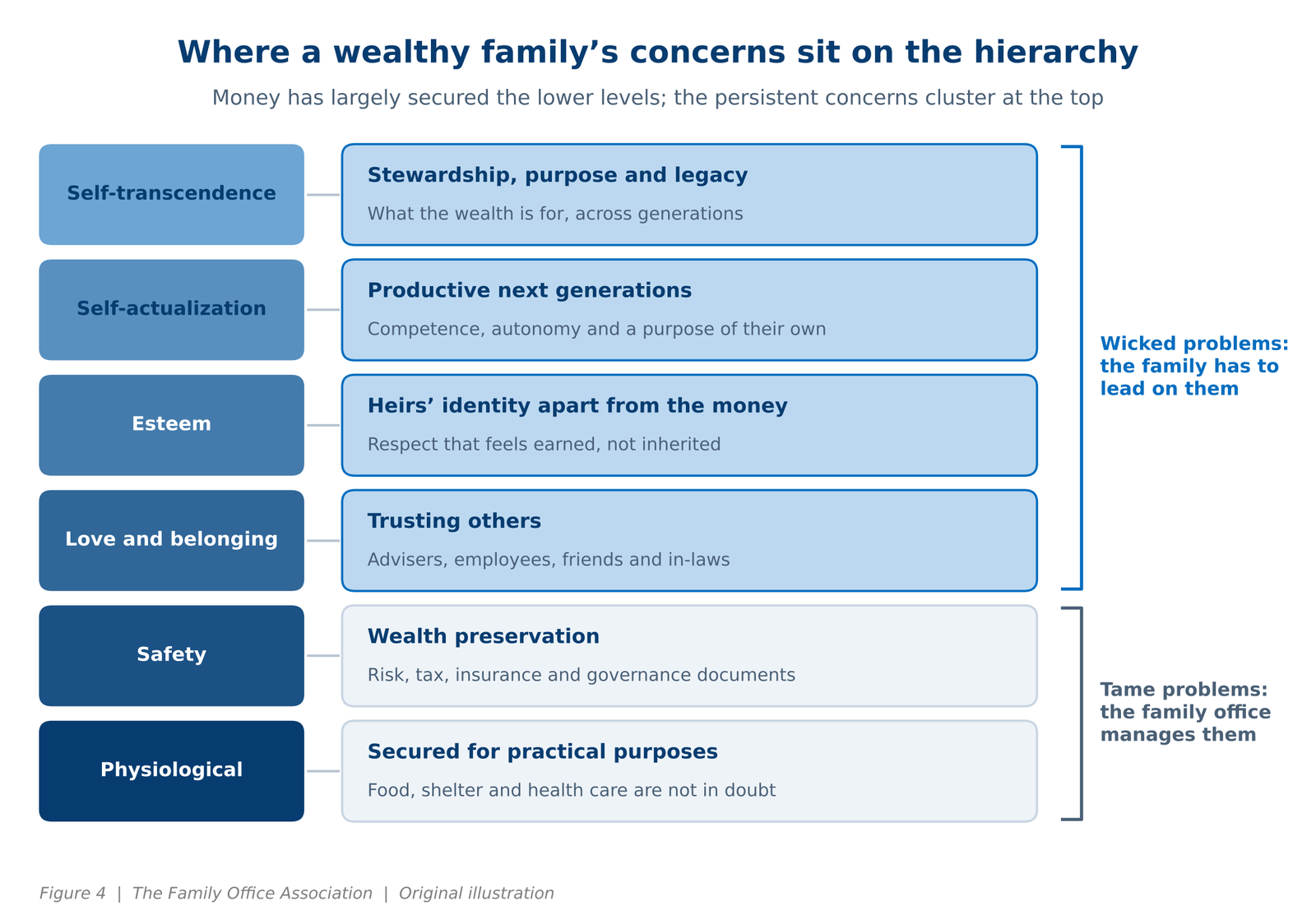
Figure 4. Recurring concerns of wealthy families placed on the hierarchy of needs. The lower levels present tame problems that a family office can manage; the upper levels present wicked problems on which the family itself must lead. Original TFOA illustration.
Stewardship of wealth
Preserving capital is a safety problem and largely a tame one: diversification, risk management, tax planning and governance documents all have defined objectives and measurable results. Stewardship is something more. Stewardship theory describes stewards as people whose interests are aligned with the long-term purposes of the organization they serve, and who are motivated by intrinsic rather than purely economic rewards (Davis et al., 1997). Asking what the wealth is for, and in whose interest it should be managed over several generations, moves the problem from the safety level to the self-transcendence level, where it has no definitive formulation.
It is also worth questioning the fear that often drives stewardship planning. The proverb that family wealth goes from shirtsleeves to shirtsleeves in three generations is widely repeated, but its empirical basis is weak (Sharpe & Morton, 2021), and the related claim that most family businesses fail by the third generation is also poorly supported (Baron & Lachenauer, 2021). The more durable risk is not that the arithmetic of a fortune fails, but that the family loses its sense of why the fortune matters.
Productive next generations
Raising capable, motivated heirs is perhaps the clearest example of a high-level problem in a wealthy family. It cannot be bought or delegated, its feedback arrives over decades, and its success has no agreed definition. The evidence suggests real risks. Holtz-Eakin et al. (1993) found that people receiving large inheritances were substantially more likely to leave the labor force, consistent with what they called the Carnegie conjecture. In family firms, the appointment of family successors as chief executive has been associated with weaker performance, particularly where the successor did not attend a selective college (Pérez-González, 2006). Studies of adolescents in affluent communities have found elevated levels of substance use, anxiety and depression, which the researchers attribute in part to pressure to achieve and to isolation from parents (Luthar & Latendresse, 2005).
Self-determination theory explains why the problem resists direct solution. Motivation that lasts depends on autonomy, competence and relatedness (Ryan & Deci, 2000). Parents can create conditions for those needs to be met, but they cannot supply them, because a sense of competence must be earned and autonomy cannot be granted on the parent’s terms. The finding that earned wealth is associated with somewhat greater happiness than inherited wealth (Donnelly et al., 2018) points the same way.
Trusting others
Wealth complicates a problem that every person faces: whom to trust. Advisers, employees, partners, friends and prospective in-laws may all have interests that diverge from the family’s. Agency theory frames part of this as the cost of delegating decisions to agents whose incentives differ from the principal’s (Jensen & Meckling, 1976), and much of the family office’s control apparatus exists to manage those costs. Trust itself is harder. Mayer et al. (1995) model trustworthiness as a combination of ability, benevolence and integrity. Ability can be verified; benevolence and integrity can only be inferred over time, from behavior in situations where betrayal would have been possible. The problem of trust therefore sits at the belonging level and shares its features: ambiguous signals, no purchase price and no stopping rule.
Purpose and legacy
At the top of the hierarchy is the question of what a fortune and a family are for. Philanthropy is one answer, and there is experimental evidence that spending on others raises the happiness of the giver more than spending on oneself (Dunn et al., 2008), although later replications by the same group, with nearly 7,900 participants across three experiments, supported the effect but found it modest and dependent on study method (Aknin et al., 2020). But purpose cannot be adopted on instruction, and a legacy cannot be verified by the people who create it. These are the most wicked problems a family faces, and the ones on which the family office’s usual tools have least purchase.
Implications: Managing Problems That Cannot Be Solved
If the problems at the top of the hierarchy cannot be solved in the way a tame problem is solved, they can still be managed well. The literature reviewed here points to six practices.
- Classify before resourcing. Ask whether a concern is tame or wicked before deciding who owns it. Grint’s (2005) distinction is a useful test: tame problems belong to management and can be delegated to the family office; wicked problems belong to the family’s own leadership and governance, where the task is to frame the right questions. Grint also warns that the classification is itself a choice, so it should be made openly rather than by default.
- Replace one-time solutions with standing processes. Where there is no stopping rule, there should be a cadence. Family councils, regular reviews of a family’s statement of purpose and periodic conversations about values treat high-level problems as continuing work rather than projects to be completed.
- Use indicators, not targets. High-level outcomes cannot be measured directly, but indicators can be agreed: whether heirs have held responsible positions outside the family enterprise, whether family members take part in governance and philanthropy, and how relationships among siblings and cousins develop. Indicators inform judgment; they do not replace it.
- Build competence and autonomy, not dependence. Consistent with self-determination theory, next-generation development works best when heirs earn responsibility in stages, gain experience outside the family’s orbit and make real decisions with real consequences.
- Structure trust deliberately. Verify ability through credentials and track record; observe benevolence and integrity over time; separate duties so that no single relationship carries unchecked authority; and accept that trust is extended in increments rather than granted once.
- Expect forecasting error and learn from peers. Because people mispredict what will fulfil them (Wilson & Gilbert, 2005), families benefit from testing ideas on a small scale and from the experience of peers who have faced the same problems. Each family’s version of a wicked problem is unique, but the patterns recur across families, which is why the experience of peers helps.
Table 2 summarizes how the character of the work changes as a family moves up the hierarchy.
Table 2. From solving to managing: how the work changes up the hierarchy
| Lower levels (physiological, safety) | Upper levels (belonging to self-transcendence) | |
|---|---|---|
| Nature of problem | Tame, well-structured | Wicked, ill-structured |
| Who owns it | Family office and advisers | Family leadership and governance |
| Main tools | Capital, expertise, insurance, controls | Conversation, example, structure, time |
| Mode of authority | Management (known processes) | Leadership (framing questions) |
| Feedback | Fast, quantitative | Slow, qualitative, often generational |
| When is it done? | When the need is met, until it recurs | Never finally; it is revisited on a cadence |
| Role of money | Decisive | Enabling at best; sometimes an obstacle |
Synthesis by the author, drawing on Rittel and Webber (1973), Simon (1973) and Grint (2005).
Limitations and Directions for Research
The framework has clear limitations. It is conceptual, and the ratings in Table 1 are judgments rather than measurements. The hierarchy of needs itself is better supported as a loose tendency than as a strict sequence (Tay & Diener, 2011; Wahba & Bridwell, 1976), and the inverted pyramid inherits that looseness. Problem difficulty is also partly socially constructed: what one family treats as a tame question of policy, another may treat as a wicked question of values (Grint, 2005). Cultural context shapes both which needs are prominent and how their problems are framed.
The framework nonetheless yields propositions that could be tested. Ratings of problem definability, measurability and purchasability could be collected for concerns at each level of need and compared. If the framework is right, those ratings should fall as the level of need rises; the association between wealth and the resolution of a concern should weaken at higher levels; and concerns at higher levels should be more often described as recurring than as resolved. Families of significant wealth are a natural population for such work, because for them the lower levels are largely held constant.
Conclusion
Maslow’s pyramid tells us what people need and in what order those needs tend to press. Sharpe’s hierarchy of problems adds a second dimension: what kind of problem each need presents. At the base, problems are concrete, measurable and solvable with resources, and solving them for everyone remains the most urgent task. At the top, problems lose their definition, their measures and their stopping rules, and money loses much of its power to help.
For families of significant wealth, this is the terrain on which the most important work takes place: stewarding a fortune for purposes beyond preservation, raising children who can find their own competence and meaning, deciding whom to trust, and leaving a legacy whose worth will be judged by others. These problems cannot be solved once and set aside. They can be recognized for what they are, given owners and a cadence, and worked on with patience and with the counsel of peers. Recognizing that higher needs bring harder problems is the first step to managing them well.
Bibliography
- Aknin, L. B., Dunn, E. W., Proulx, J., Lok, I., & Norton, M. I. (2020). Does spending money on others promote happiness?: A registered replication report. Journal of Personality and Social Psychology, 119(2), e15–e26. https://doi.org/10.1037/pspa0000191
- Baron, J., & Lachenauer, R. (2021, July 19). Do most family businesses really fail by the third generation? Harvard Business Review. https://hbr.org/2021/07/do-most-family-businesses-really-fail-by-the-third-generation
- Brickman, P., Coates, D., & Janoff-Bulman, R. (1978). Lottery winners and accident victims: Is happiness relative? Journal of Personality and Social Psychology, 36(8), 917–927.
- Bridgman, T., Cummings, S., & Ballard, J. (2019). Who built Maslow’s pyramid? A history of the creation of management studies’ most famous symbol and its implications for management education. Academy of Management Learning & Education, 18(1), 81–98. https://doi.org/10.5465/amle.2017.0351
- Davis, J. H., Schoorman, F. D., & Donaldson, L. (1997). Toward a stewardship theory of management. Academy of Management Review, 22(1), 20–47.
- Donnelly, G. E., Zheng, T., Haisley, E., & Norton, M. I. (2018). The amount and source of millionaires’ wealth (moderately) predict their happiness. Personality and Social Psychology Bulletin, 44(5), 684–699. https://doi.org/10.1177/0146167217744766
- Dunn, E. W., Aknin, L. B., & Norton, M. I. (2008). Spending money on others promotes happiness. Science, 319(5870), 1687–1688. https://doi.org/10.1126/science.1150952
- Grint, K. (2005). Problems, problems, problems: The social construction of “leadership.” Human Relations, 58(11), 1467–1494. https://doi.org/10.1177/0018726705061314
- Herzberg, F., Mausner, B., & Snyderman, B. B. (1959). The motivation to work. Wiley.
- Holtz-Eakin, D., Joulfaian, D., & Rosen, H. S. (1993). The Carnegie conjecture: Some empirical evidence. Quarterly Journal of Economics, 108(2), 413–435.
- Jensen, M. C., & Meckling, W. H. (1976). Theory of the firm: Managerial behavior, agency costs and ownership structure. Journal of Financial Economics, 3(4), 305–360.
- Kahneman, D., & Deaton, A. (2010). High income improves evaluation of life but not emotional well-being. Proceedings of the National Academy of Sciences, 107(38), 16489–16493.
- Kasser, T., & Ryan, R. M. (1993). A dark side of the American dream: Correlates of financial success as a central life aspiration. Journal of Personality and Social Psychology, 65(2), 410–422. https://doi.org/10.1037/0022-3514.65.2.410
- Kaufman, S. B. (2023). Self-actualizing people in the 21st century: Integration with contemporary theory and research on personality and well-being. Journal of Humanistic Psychology, 63(1), 51–83. https://doi.org/10.1177/0022167818809187
- Kenrick, D. T., Griskevicius, V., Neuberg, S. L., & Schaller, M. (2010). Renovating the pyramid of needs: Contemporary extensions built upon ancient foundations. Perspectives on Psychological Science, 5(3), 292–314. https://doi.org/10.1177/1745691610369469
- Keynes, J. M. (1931). Economic possibilities for our grandchildren. In Essays in persuasion (pp. 358–373). Macmillan. (Original work published 1930)
- Killingsworth, M. A., Kahneman, D., & Mellers, B. (2023). Income and emotional well-being: A conflict resolved. Proceedings of the National Academy of Sciences, 120(10), e2208661120. https://doi.org/10.1073/pnas.2208661120
- Koltko-Rivera, M. E. (2006). Rediscovering the later version of Maslow’s hierarchy of needs: Self-transcendence and opportunities for theory, research, and unification. Review of General Psychology, 10(4), 302–317.
- Luthar, S. S., & Latendresse, S. J. (2005). Children of the affluent: Challenges to well-being. Current Directions in Psychological Science, 14(1), 49–53. https://doi.org/10.1111/j.0963-7214.2005.00333.x
- Maslow, A. H. (1943). A theory of human motivation. Psychological Review, 50(4), 370–396.
- Maslow, A. H. (1967). A theory of metamotivation: The biological rooting of the value-life. Journal of Humanistic Psychology, 7(2), 93–127.
- Maslow, A. H. (1971). The farther reaches of human nature. Viking Press.
- Mayer, R. C., Davis, J. H., & Schoorman, F. D. (1995). An integrative model of organizational trust. Academy of Management Review, 20(3), 709–734.
- McDermid, C. D. (1960). How money motivates men. Business Horizons, 3(4), 93–100.
- Nielsen, N. (2016, May 26). Inverting Maslow’s hierarchy: Self-actualization versus ordinary human unhappiness. Medium. https://jnnielsen.medium.com/inverting-maslows-hierarchy-b2c32156f091
- Pérez-González, F. (2006). Inherited control and firm performance. American Economic Review, 96(5), 1559–1588. https://doi.org/10.1257/aer.96.5.1559
- Reitman, W. R. (1964). Heuristic decision procedures, open constraints, and the structure of ill-defined problems. In M. W. Shelly & G. L. Bryan (Eds.), Human judgments and optimality (pp. 282–315). Wiley.
- Rittel, H. W. J., & Webber, M. M. (1973). Dilemmas in a general theory of planning. Policy Sciences, 4(2), 155–169.
- Ryan, R. M., & Deci, E. L. (2000). Self-determination theory and the facilitation of intrinsic motivation, social development, and well-being. American Psychologist, 55(1), 68–78.
- Sharpe, M. J., & Morton, S. (2021, November 5). Family wealth in three generations. The Family Office Association. https://tfoa.info/publication/reconsidering-family-wealth-in-three-generations/
- Sheridan, S. (2023, April 30). The inverted Maslow hierarchy. https://simonsheridan.me/ideas/the-inverted-maslow-hierarchy/
- Simon, H. A. (1973). The structure of ill structured problems. Artificial Intelligence, 4(3–4), 181–201.
- Tay, L., & Diener, E. (2011). Needs and subjective well-being around the world. Journal of Personality and Social Psychology, 101(2), 354–365.
- Wahba, M. A., & Bridwell, L. G. (1976). Maslow reconsidered: A review of research on the need hierarchy theory. Organizational Behavior and Human Performance, 15(2), 212–240. https://doi.org/10.1016/0030-5073(76)90038-6
- Wilson, T. D., & Gilbert, D. T. (2005). Affective forecasting: Knowing what to want. Current Directions in Psychological Science, 14(3), 131–134.
- Wood, G. (2011, April). Secret fears of the super-rich. The Atlantic.
- Figures 1 to 4 are original illustrations prepared by The Family Office Association for this paper. Figure 2 plots Maslow’s (1943) hypothetical percentages; Figures 1, 3 and 4 are conceptual.
Frequently Asked Questions
What is Sharpe’s hierarchy of problems?
It is an inverted pyramid drawn alongside Maslow’s hierarchy of needs. Maslow’s pyramid is broadest at the base because basic needs are the most universal and urgent. The hierarchy of problems is broadest at the top because the problems attached to higher needs, such as esteem, self-actualization and self-transcendence, are the hardest to define, measure and solve.
Did Maslow draw the pyramid?
No. Bridgman, Cummings and Ballard (2019) searched Maslow’s published work and archives and found no trace of him presenting the hierarchy as a pyramid. The pyramid they identified as probably the earliest appeared in a 1960 management article by Charles McDermid. Maslow also stressed that needs are only partly satisfied at any time, not met one level at a time.
What makes a problem hard to define?
The paper uses four dimensions drawn from research on ill-structured and wicked problems (Simon, 1973; Rittel and Webber, 1973): whether the goal is clear, whether progress can be measured, whether the solution can be bought or delegated, and whether there is a stopping rule at which the problem is finished. Problems that fail these tests are wicked rather than tame.
Does the framework minimize basic needs?
No. Basic needs come first, and their deprivation is the more urgent suffering. The hierarchy of problems describes the shape of problems, not a ranking of hardship. For someone without resources, the base of the pyramid is the hardest place of all, and at the scale of a society, problems such as poverty are themselves wicked.
Why does money do so little for higher-level problems?
Money solves purchasable problems such as food, housing and security. Higher needs depend on relationships, competence, autonomy and meaning, which must be built, earned or freely given. Among millionaires, greater wealth was linked to greater happiness only above about $8 million to $10 million, and the differences were modest (Donnelly et al., 2018).
How does the framework apply to wealthy families?
For families of significant wealth, the lower levels are largely secure and the family office keeps them that way. The concerns that remain cluster near the top: stewarding wealth for a purpose, raising productive next generations, deciding whom to trust, and leaving a legacy. These are wicked problems on which the family itself has to lead.
Why is raising productive heirs such a hard problem?
It cannot be bought or delegated, its results take decades to show, and success has no agreed definition. Research links large inheritances to leaving the labor force (Holtz-Eakin et al., 1993), and self-determination theory holds that lasting motivation depends on autonomy, competence and relatedness, which parents can encourage but cannot supply.
How should a family manage problems it cannot solve?
By classifying each concern as tame or wicked before deciding who owns it, replacing one-time solutions with standing processes such as family councils, using indicators rather than targets, building heirs’ competence and autonomy, structuring trust deliberately, and learning from peers who have faced similar problems.
Frequently Asked Questions
What are the levels of Maslow’s hierarchy of needs?
Maslow (1943) proposed five sets of basic needs: physiological, safety, love and belonging, esteem, and self-actualization. In later work he described motives that reach beyond the self, and Koltko-Rivera (2006) reconstructed from those writings a sixth level, self-transcendence, above self-actualization.
Is Maslow’s hierarchy supported by evidence?
Only partly. An early review found partial support for a need hierarchy and none from longitudinal studies (Wahba and Bridwell, 1976). A study of 60,865 people in 123 countries found that needs tend to be met in a broadly consistent order, but only loosely, and that higher needs matter for well-being in their own right (Tay and Diener, 2011).
What is a wicked problem?
Rittel and Webber (1973) used the term for problems that resist definitive formulation: they have no stopping rule, their solutions are better or worse rather than right or wrong, and there is no conclusive test of success. Tame problems, by contrast, can be specified, solved and checked.
Does more wealth make people happier?
For most people, happiness rises with the logarithm of income, so each additional dollar matters most to those who have least (Killingsworth, Kahneman and Mellers, 2023). Among millionaires, more wealth was linked to modestly greater happiness only at high levels, and those who earned their wealth were somewhat happier than those who inherited it (Donnelly et al., 2018).
About the Author
Marc J. Sharpe, M.A., M.Phil., MBA is a global investment executive and board member with a career spanning family office management, private equity, venture capital, and investment banking. Known for his strategic insight, deep expertise in family office governance, and ability to foster innovation and value creation, Mr. Sharpe has built and led investment platforms that deliver sustainable growth while navigating complex financial and operational challenges. His leadership style emphasizes integrity, continuous improvement, and long-term partnerships that generate significant stakeholder value. Mr. Sharpe is the Founder and Chairman of The Family Office Association, a premier global peer network of single-family offices. Since 2007, he has cultivated a community of senior family office executives and principals representing some of the world’s wealthiest families, promoting education, shared-best practices, and co-investment opportunities. Under his leadership, TFOA has become a trusted forum for collaboration, market insight, and proprietary investment deal flow on a global scale. He also teaches an MBA class on “The Entrepreneurial Family Office” as an Adjunct Professor at Rice University and Southern Methodist University. Mr. Sharpe holds an M.A. from Cambridge University, an M.Phil. from Oxford University, and an MBA from Harvard Business School. Contact: marc@tfoa.me
About TFOA
The Family Office Association (“TFOA”) is a global peer network that serves as the world’s leading single family office community. Our group is for education, networking, selective co-investment, and a resource for single family offices to share ideas, deal flow and best practices. Members are not actively marketing products or services to other members, and no contact information or email lists will ever be shared. Since our founding in 2007, TFOA has led the global single family office community by delivering world-class educational content, unique networking opportunities, and exceptional thought leadership to our highly curated network of the world’s largest and wealthiest families: www.tfoa.info
Disclosures
This paper is for informational and educational purposes only. It presents a conceptual framework, not the results of an empirical study, and the ratings in Table 1 and Figure 3 are the author’s qualitative judgments. References to published research summarize the findings reported by their authors. Nothing in this paper is a substitute for professional psychological, medical, legal, tax or investment advice. The figures in this paper are original illustrations prepared by The Family Office Association. They reproduce no third-party artwork.
The Family Office Association (“TFOA”) is a peer network of single family offices. Our community is intended to provide members with educational information and a forum in which to exchange information of mutual interest. TFOA does not participate in the offer, sale or distribution of any securities nor does it provide investment advice. Further, TFOA does not provide tax, legal or financial advice. Materials distributed by TFOA are provided for informational purposes only and shall not be construed to be a recommendation to buy or sell securities or a recommendation to retain the services of any investment adviser or other professional adviser. The identification or listing of products, services, links, or other information does not constitute or imply any warranty, endorsement, guaranty, sponsorship, affiliation, or recommendation by TFOA. Any investment decisions you may make based on any information provided by TFOA is your sole responsibility. The TFOA logo and all related product and service names, designs, and slogans are the trademarks or service marks of The Family Office Association. All other product and service marks on materials provided by TFOA are the trademarks of their respective owners. All of the intellectual property rights of TFOA or its contributors remain the property of TFOA or such contributor, as the case may be, such rights may be protected by United States and international laws and none of such rights are transferred to you as a result of such material appearing on the TFOA web site. The information presented by TFOA has been obtained by TFOA from sources it believes are reliable. However, TFOA does not guarantee the accuracy or completeness of any such information. All such information has been prepared and provided solely for general informational purposes and is not intended as user specific advice.

