
Fact or Fear-Based Marketing?
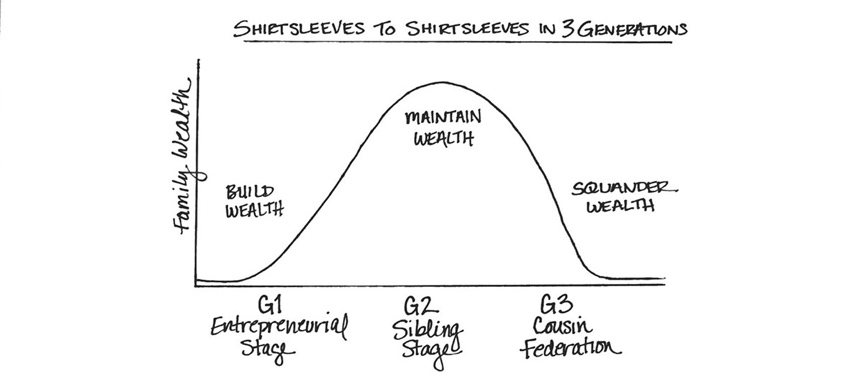
First generation families who are in the process of building a family office often receive the same piece of conventional wisdom: that family wealth passes from “shirtsleeves to shirtsleeves in three generations.” A punchier version is also frequently quoted : “Generation one makes it, Generation two spends it, Generation three blows it.” But where does this ‘universally accepted’ conventional wisdom come from? And why is it so ubiquitous among family office service providers and wealth advisors in the marketplace?
In 2021, Josh Baron and Rob Lachenauer wrote an article in the family business section of the Harvard Business Review that calls into question the validity of this oft quoted phrase.1 They go on to question the very foundation upon which so much advice has been rendered to wealthy families looking to build their legacy. For Baron and Lachenauer, the expression traces back to a decades old study of manufacturing companies in Illinois. They also cite other studies regarding the dynamics of multi-generational wealth that suggest wealthy families tend to stay wealthy. Given Baron and Lachenauer’s research, it’s worth reexamining the phrase, both for its value and for the ways it may unfairly or inaccurately portray the dynamics of family wealth. And, of course, we shouldn’t forget how the Estate Planning and Private Wealth ‘industrial complex’ uses this broadly accepted concept to help their clients (and make more money).
While Baron and Lachenauer cite a 1980s study as their starting point for this concept as it relates to family offices, James E. Hughes used this phrase in the beginning of his landmark text Family Wealth, first published in 1997.2 Hughes used this phrase to not only shape the purpose of his book, but also his entire career. He found both the international character and the utilization of intergenerational dynamics uniquely compelling and appropriate for his work. Hughes, and others after him, observed that many cultures have some version of this expression. Indeed, its international ubiquity is quite remarkable. Germanic, Romantic, Slavic, and Asian cultures all seem to possess some version of this expression.
- In China: “From peasant shoes to peasant shoes in three generations.”
- In Mexico: “Father-merchant, son-gentleman, grandson-beggar.
- In Brazil: “Rich father, noble son, poor grandson.”
- In Italy: “From the stables to the stars and back to the stables in three generations.”
For Hughes, this expression speaks to a universal dynamic that informs family wealth. He himself was quite explicit in his writing that the purpose of his life, working with families and family offices, was dedicated to discovering the traits successful families use to break this cycle and to help other families implement best practices so that they might avoid this fate. Anecdotally, he observes a number of families that were unable to overcome this dynamic. Those families splintered and the wealth became fractured and lost. There are innumerable examples of this in the literature. For instance, in 2017 Frances Stroh wrote a heartfelt and personal memoir called Beer Money: A Memoir of Privilege and Loss, which detailed her family’s rise and precipitous fall. Stroh was the heiress to what was at the time the largest private beer company in the United States. Her book details the myriad forces that dismantled her family’s fortune. Some of these were macroeconomic conditions, but many had to do with tensions, disagreements, and losses within the family across multiple generations. Happily, Stroh was able to rebuild a small portion of her family’s wealth and turned it toward reinvestment in Detroit, as well as engagement with non-profits operating in the Detroit area. While Stroh has shared her family story with the public, anyone with experience in the family office world is familiar with stories like hers. Stroh herself said that after publishing the book many people reached out to her to tell their own story of lost family fortunes.3
Examples like the Stroh family suggest there is some wisdom within the shirt-sleeves expression. Many of the best practices in family office design are built with an eye toward preparing the next generation of family leadership and helping to enshrine the values of one generation for future generations. This work helps make family offices resilient and dynamic organizations that can evolve and grow over time. However, Baron and Lachenauer are correct to call into question the assumptions that are embedded with this blanket statement. Despite the accepted wisdom the phrase captures, it is often used in a fatalistic fashion, as a scare tactic for any family thinking about creating a family office: “if you don’t listen to our advice, you grandchildren may have nothing”. Sadly, the fatalism of this expression is frequently used as a marketing technique by estate planners and wealth advisors, and as a scare tactic, meant to elicit a fear-based reaction.
The reality is, of course, more complex. According to Gregory Clark, an economist at UC Davis who studies social mobility, when it comes to elite families, the regression to the mean occurs over centuries, not generations. Clark’s study focuses on elite English surnames from the 12th century to the 19th century. He found a remarkably consistent retention of elite status across that 700 year period4. Similarly, many of today’s wealthiest families in Italy trace their lineage to the Renaissance5. Clearly the picture of dynastic family wealth is more complex than an aphorism about poor tailoring. So, what does this all mean for you and your family office?
First, if someone is using this expression with you, be sure to carefully consider the context and purpose of its use. One should always be wary of those using scare tactics to garner attention and obfuscate rational decision making. Hughes offers the best example of how to use this expression well. For him the expression was just the beginning. The value that he brought to countless families was through the very real and tangible processes and systems he designed to help families govern themselves more effectively. Hughes’ work is not cold and impersonal. As an attorney he understood the formal legal structures that underpin a family office, but he also understood that the legitimacy and efficacy of these structures was more a function of culture and relationships. His work brings to light a humanistic character to family office governance. The ultimate truth that he drew from the “shirtsleeves” expression is that institutional family wealth is made up of individual participants and those individuals have their own ideas, both rational and irrational, that shape how that wealth is managed. Given this understanding, Hughes turned his focus to understanding behavior, looking for models to help each individual achieve their very best.
Second, consider the source. One of the most valuable assets that a new family office can utilize is a trusted peer network of similar families that have managed their generational transition well.6 In lieu of those networks, finding individuals who have delivered real results in this area is worth much more than an oft cited platitude about multi-generational family wealth transfer.
Finally, while economic data show that family wealth is more resilient than sometimes appears, this doesn’t mean that foundational practices like governance and legacy planning are futile exercises. Devising a plan and creating a culture for rising generations to grow and develop their own form of leadership are essential practices for any family office seeking a multi-generational enterprise. As Hughes’ work shows us, these efforts are more than complex legal structures. They must also put the family and their vison, hopes, and objectives at the center. This shouldn’t be a fear-based process, but rather a deliberate and thoughtful process to enable the very best personal and professional outcomes for your family, business, and family office.
Notes
- Josh Baron and Rob Lachenauer, “Do Most Family Businesses Really Fail by the Third Generation?” Harvard Business Review Blog, 19 July 2021. https://hbr.org/2021/07/do-most-family-businesses-really-fail-by-the-third-generation
- James E Hughes, Family Wealth: Keeping it in the Family . Bloomberg Press, 1997.
- https://www.nytimes.com/2017/02/19/your-money/losing-a-fortune-often-comes-down-to-one-thing-family.html
- https://www.livescience.com/48951-surnames-social-mobility.html
- https://www.vox.com/2016/5/18/11691818/barone-mocetti-florence
- In an earlier whitepaper, “Family Office Networks, Clubs, and Associations: What Would Groucho Marx Do?” we provide an analysis of the most common business models for family office networks as well as helpful considerations for each type.
Frequently Asked Questions
What does 'shirtsleeves to shirtsleeves in three generations' mean?
'Shirtsleeves to shirtsleeves in three generations' is a piece of common wisdom holding that family wealth is built, spent, and lost across three generations, often put as 'Generation one makes it, Generation two spends it, Generation three blows it.' Many cultures have a version of the saying, which suggests it points to a widely felt pattern in family wealth.
Is it true that most family wealth disappears by the third generation?
The claim that most family wealth disappears by the third generation is more myth than proven fact, as the original saying traces back to a decades-old study of Illinois manufacturing companies. Research by Josh Baron and Rob Lachenauer in a 2021 Harvard Business Review article questions whether it holds up, citing studies suggesting wealthy families actually tend to stay wealthy.
Why do wealth advisors use the 'three generations' phrase so often?
Wealth advisors and estate planners often use the 'three generations' phrase as a marketing line and scare tactic to stir a fear-based reaction, hinting that without their advice a family's grandchildren could end up with nothing. The Estate Planning and Private Wealth 'industrial complex' leans on this widely accepted idea to win clients, so families should think hard about the context and motive when they hear it.
What does research actually show about how long elite family wealth lasts?
Research shows elite family wealth is far more durable than the saying suggests, with a slide back toward average wealth happening over centuries rather than generations. Economist Gregory Clark of UC Davis studied elite English surnames from the 12th to 19th century and found remarkably steady retention of elite status across that 700-year span, while many of Italy's wealthiest families trace back to the Renaissance.
Who was James E. Hughes and what did he say about family wealth?
James E. Hughes was an attorney and author of the landmark 1997 book 'Family Wealth,' who used the shirtsleeves saying to shape his career studying how successful families break the cycle of lost wealth. He stressed that family wealth is made up of individual people, turning his focus to understanding behavior and building governance systems rooted in culture and relationships.
How is the Stroh family used as an example of lost family fortunes?
The Stroh family shows how fortunes can be lost: Frances Stroh, heiress to what was then the largest private beer company in the United States, wrote the 2017 memoir 'Beer Money' about her family's rise and steep fall. While some causes were broad economic forces, many came from tensions, disagreements, and losses within the family across several generations.
Does family wealth being resilient mean governance and legacy planning don't matter?
No, the durability of family wealth does not make governance and legacy planning pointless. Building a plan and creating a culture that lets rising generations develop their own leadership remain essential for any family office aiming for a multi-generational enterprise. These efforts go beyond complex legal structures and must put the family's vision, hopes, and goals at the center through a deliberate, not fear-based, process.
What should a new family office do instead of relying on the three generations cliche?
A new family office should weigh the source and lean on a trusted peer network of similar families that have handled generational transitions well, which is one of its most valuable assets. Finding people who have delivered real results is worth far more than an oft-repeated platitude, and families should be wary of anyone using scare tactics to cloud rational decision-making.
About the Authors
Marc J. Sharpe is the founder and Chairman of TFOA, an organization formed in 2007 to provide a forum for education and networking and to serve as a resource for single family office principals and professionals to share ideas and best practices, pool buying power, leverage talent and conduct due diligence. Mr. Sharpe also teaches an MBA class on “The Entrepreneurial Family Office” as an Adjunct Professor at Rice University and SMU Cox School of Business. Contact: marc@tfoa.me
Seth Morton, Ph.D. has served family offices in areas of investment diligence, execution, and management; governance; research; communications; and multi-generational, sustainable legacy planning. He seeks to improve team performance by cultivating learning-focused and communications-driven processes that deliver exceptional results. He and his family are currently based in Texas.
About TFOA
The Family Office Association (“TFOA”) is a global peer network that serves as the world’s leading single family office community. Our group is for education, networking, selective co-investment, and a resource for single family offices to share ideas, deal flow and best practices. Members are not actively marketing products or services to other members and no contact information or email lists will ever be shared. Since our founding in 2007, TFOA has led the global single family office community by delivering world-class educational content, unique networking opportunities, and exceptional thought leadership to our highly curated network of the world’s largest and wealthiest families: www.tfoa.info
Disclosures
The Family Office Association (“TFOA”) is a peer network of single family offices. Our community is intended to provide members with educational information and a forum in which to exchange information of mutual interest. TFOA does not participate in the offer, sale or distribution of any securities nor does it provide investment advice. Further, TFOA does not provide tax, legal or financial advice. Materials distributed by TFOA are provided for informational purposes only and shall not be construed to be a recommendation to buy or sell securities or a recommendation to retain the services of any investment adviser or other professional adviser. The identification or listing of products, services, links, or other information does not constitute or imply any warranty, endorsement, guaranty, sponsorship, affiliation, or recommendation by TFOA. Any investment decisions you may make based on any information provided by TFOA is your sole responsibility. The TFOA logo and all related product and service names, designs, and slogans are the trademarks or service marks of The Family Office Association. All other product and service marks on materials provided by TFOA are the trademarks of their respective owners. All of the intellectual property rights of TFOA or its contributors remain the property of TFOA or such contributor, as the case may be, such rights may be protected by United States and international laws and none of such rights are transferred to you as a result of such material appearing on the TFOA web site. The information presented by TFOA has been obtained by TFOA from sources it believes are reliable. However, TFOA does not guarantee the accuracy or completeness of any such information. All such information has been prepared and provided solely for general informational purposes and is not intended as user specific advice.
Frequently Asked Questions
What does 'shirtsleeves to shirtsleeves in three generations' mean?
This proverb — found in cultures around the world — describes the common pattern of wealth being created in the first generation, enjoyed and somewhat dissipated in the second, and largely gone by the third. Research suggests this pattern is more the norm than the exception, driven by inadequate preparation of heirs, family conflict, and poor governance.
How do families successfully transfer wealth across generations?
Successful multi-generational wealth transfer combines financial planning (estate structures, trusts, gifting strategies) with family capital development — educating the next generation about money, investing, and responsibility, establishing shared family values and governance, and gradually transitioning decision-making authority as younger members demonstrate capability.
What is the role of the family office in next-generation education?
The family office often serves as the primary vehicle for next-generation financial education — through structured programs, shadowing of investment professionals, participation in family governance meetings, and gradually increasing involvement in investment decisions. Some family offices fund formal education programs or engage outside advisors specializing in family wealth education.
What is a family governance framework for wealth continuity?
A family governance framework is the set of structures and processes that guide collective decision-making — including a family council, investment committee, family constitution, regular family meetings, and defined rules for family participation in the family office. Strong governance is the most reliable predictor of long-term wealth continuity.


